Wise Woman Travel

Exploring the world from a female perspective

Cozy.

I wonder what chance meeting inspired this word  to skate over from the Norwegian kos seg and cuddlle down at the hearth of 18th century Scots, where it felt so comfy, it decided to stay and change its name to colsie.  Could it have been an invitation from one trader to another to enjoy the  refuge of a sod-roofed  cottage, turf fire glowing? A chat between quilt makers, showing off their craft?  A coy offer from a Norse goddess to a man in plaid?

Etymologists leave that story to our imaginations.  But they’re fairly certain that down through the ages, the word “cozy” has always meant cozy.   I like knowing that. It suggests a long-standing human need  for places and situations that provide warmth, comfort, and relaxation. Whether facing the harshness of life on the fjords or moors 300 years ago, or struggling with 21st century stressors, it seems that our craving for cozy is innate.

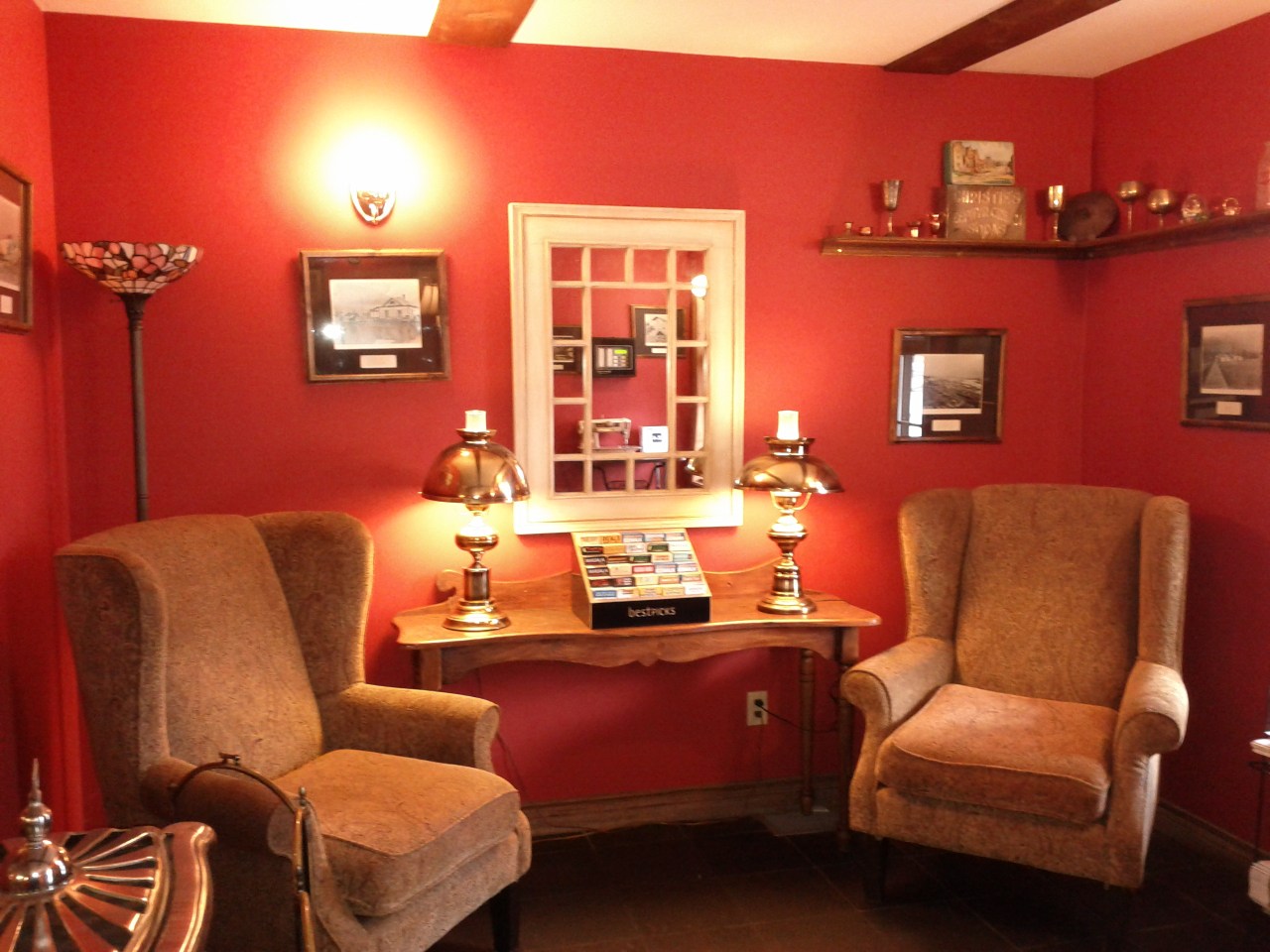
IMG_20140215_141537My husband and I are no different. When we’re knee deep in February, and spring seems to be in permanent hibernation, we sometimes seek solace at the Georgetown Inn in Canmore, a comfortable 3.5 hour drive southwest into the Rocky Mountains. The Inn is one of twelve Charming Inns of Alberta, each of which has its own personality to share with travellers. The lobby of the Georgetown, named for a small community that served a short-lived coal  mine in the early 20th century, is as welcoming and unassuming as your favorite granny’s home.  You’ll be greeted by  wing chairs, a grandfather clock, and a nostalgic second look at your mother’s old Singer sewing machine,  your uncle’s battered typewriter , and the yellowed history book you once found pushed back on a dusty library shelf.IMG_20140214_155723

There are only 20 rooms at the Georgetown, each uniquely cozy.  Indulging in either a “Victoria” or an “Albert”  gets you a sitting room separate from the bedroom, a hot tub, and a fireplace – but there are room options for every budget. The “glad you’re here” lobby ambience follows you into your room, where you’ll find homemade cookies and a floral tea set on a tray, just waiting for you to enjoy a steaming cuppa.IMG_20140214_154825

From that point on, you can be as active or as lazy as you want. We have sometimes cross-country skied the trails around the Canmore Nordic Centre, drinking in the azure skies and the snow-striated mountain peaks. But this year, we opted for  low-key lesiure. We watched more and less of several classic Academy Award nominee films.  I delighted one more time in the Raindrops Keep Fallin’ On My Head biking scene from Butch Cassidy and the Sundance Kid.  And if you’ve never seen Tennessee Williams’ sizzling Cat on a Hot Tin Roof, with Paul Newman and Elizabeth Taylor, I highly recommend it.

Our most ambitious activity was a trip to Banff, Canmore’s more well-known, glamorous, up the road sister.  If you’ve never been to Banff, it’s worth the trip for sure. But the main street is crowded with tourists and tourist amenities, both of which we were glad to leave behind for the quieter community feel of Canmore. Although it has fewer shops,  the merchandise for sale is less kitschy,  you’ll be supporting more local business owners, and you’ll have ample room to breathe as you make your purchases.

Canmore also offers a selection of interesting places to eat. We enjoyed small plate dining at Tapas  restaurant one evening, and Thai, French, Mexican, and East Indian culinary experiences were in easy reach as well . But when it came time to either put on our coats and drive a few minutes to have a meal, or wander down the hall in our sheepskin slippers to the Georgetown’s Miner’s Lamp Dining Room and Pub, you can guess which we chose. IMG_20140214_160242  At breakfast, we were often the only patrons, sitting at the table closest to the fireplace, drinking third and fourth cups of coffee as the flames flickered and danced. In the evening,  groups of local friends and families dropped by the pub for a draft or fish ‘n’ chips or shepherd’s pie. If you don’t even have enough energy to leave your room for dinner, the Georgetown will happily  provide you with a picnic basket,  wine, and chocolate-dipped strawberries.IMG_20140214_155246

When we arrived home from Canmore, we realized that the middle of the month had disappeared and we were on the downward slope to March.  On my walk to work this morning, I heard birdsong for the first time in weeks, and it was already light  So, if winter is dragging you under a little right now, and you’re feeling a lot less than cozy, keep in mind the easy-to-access destinations that could be waiting for you a few hours from where you’re reading this post. While it’s true that a change is as good as a rest, it’s even better when you can find both in the same short-hop vacation .

Photo credit; Lorne Dmitruk

St. Lucia blues (the good kind)
Photo credit: Lorne Dmitruk

From time to time, I’ve slipped the surly bonds¹ of prairie winter and booked a tropical  vacation. In 2010, my husband and I celebrated my newly-awarded doctoral degree, dipping our toes into St. Lucia’s white sands and turqoise surf. Last year, our Save-on-More grocery points bought us two  tickets to Mazatlan, where we ambled along Mexico’s longest seawall and explored the cobbled streets of the city’s quaint old town.

Mazatlan sea wall

View from the Mazatlan sea wall

More often, though, if you knock on my door during January and February, you’ll  find me at home – and most of the time,  I’m OK with that.  Maybe I don’t miss what I’ve rarely had.  When you’re a teacher, as I’ve been for much of my career,  administration takes a dim view of abandoning your students right after the Christmas break for less sullen climes and faces.  Not only that, being a child of the prairies, I actually like cozying up in the evenings with Christmas gift books, or turning out the kitchen light to watch snow drift down from the night sky.

Villefranche-sur-mer ramblings

Villefranche-sur-mer ramblings

And on winter Sunday evenings, my husband makes soul-warming dinners of chili and garlic bread, steak and mashed potatoes. This year, he’s been pouring us a pre-meal aperitif of pastis over ice. Its licorice briskness returns me to our sun-splashed  wanderings around Provence last fall. So I’m fairly content right now not to be packing my bags for another major getaway.

But.

This morning, the mercury is quivering at minus 22C.  When we shop for groceries this afternoon,  we’ll be smacked around by winds that will  make the temperature feel more like minus 32.²  My eyes are getting weary  of the black and white still life that is Alberta winter in the city.  I crave any color or sound or smell that tells me nature hasn’t totally abandoned us.  And as winter trudges along, the day-to-dayness of my duties and routines is wearing as thin as a thread-bare quilt.

So, how to have a winterruption ³ without resorting to equatorial relief?  I’ve got some ideas, and I’m  inviting you along to try them out. You won’t need to pack your suitcase, or even leave your house. But I do have one request.  After you read the posts, if you feel inspired to share your own methods for staring down February, do tell. What local harbours do you sail into  when you need a respite from winter?  I’d be especially interested in hearing from those of you who don’t live in frigidly cold climates but still experience the February fidgets. Or maybe, if you live in the southern hemisphere, your fidgets come at a different time of year. That would be fascinating to know about too.

Let’s help each other put a little  spring in our steps, long before we can chuck off our  boots for good.

Summer under wraps for another three months

Summer under wraps for another three months

¹This phrase is from the poem High Flight, by John Magee.

²For those of you on the Fahrenheit scale, when we hit minus 40 C, it will feel the same as your minus 40 F.

³Thanks, Travelocity.ca, for this clever word.

This is the second in a series of posts by Christie Robertson, who is preparing to welcome her first child in April. This month, we join Christie and her dog Molly on a learning journey they took together, and see how it helped to inform Christie’s ideas about asking for parenting advice.
_____________________________________________________________________________________________________

“Molly, no. Stop. Bad dog.  Heel!  Eerrraaaaaaaargh!!”  The leash has become a chain and Molly my jailer. My arm is wrenched ceaselessly from side-to-side by my unheeling dog who ravenously wants to go faster, farther and forever.

I pull back with a sharp tug only for my exhausted arm and aching hand to be yanked forward again by 50 pounds of jaunty puppy.  The rational, calm, sane, adult part of me watches helplessly as I stop dead and begin a round of childlike foot stamping  pouting and crying, “No, no, no, no!  Bad dog!”   A somewhat violent “I detest you” is whispered under my breath as I slouch in defeat.  The local children I had imagined would come running, pushing past each other to be first to pet Molly, are hiding behind bushes and gates quivering in fear.  And it’s not Molly that is scaring them.

I wipe the tears from my eyes and decide Molly can pull all she wants on the damn leash.  I just don’t care anymore if she heels or not.  I text my husband Matt a picture of Molly’s glorious win and continue the walk with Molly in the lead.

molly unheeling on the leash

Who knew how frustrating it could be to own a dog.  In a previous post I mentioned that dogs thrive on pack behaviour (they want to follow a leader).  So why the heck is my dog so stubborn and wanting to lead me?  And if I can’t train a dog to listen, and I had been trying for the past year, then is this a sign of my impending epic failure as a parent?

By the next day, once I had convinced myself that the dog was not, in fact, devil’s spawn and that I did still love her, I admitted I needed help.  We had owned Molly for about a year and, until the tug-of-war incident,  I was content to watch The Dog Whisperer, read books and figure this training thing out on my own.  These strategies were obviously not working, so I enlisted the help of a local trainer.

After one session, Molly was recognizing that the leash existed (we were in fact tethered together, imagine that!).  More sessions and practice and Molly was pausing and waiting for me whenever the leash got taut.  Today, Molly still doesn’t heel right beside me, but I have learned it is all about setting clear expectations.  I am happy that she is not pulling anymore and don’t push her further into learning the perfect heel. I also know what I could do if this were important to me.

Asking for help.  What a simple yet often shunned part of learning.  Why are we so proud as to think we can tackle complex, new experiences on our own?  The main lesson I have taken from this experience is I shouldn’t be ashamed to seek assistance. This is especially true with raising children.  Even though I have yet to hold my little bundle of joy in my hands, I have already begun asking my loved ones and friends for advice:

  • Diapers: cloth or disposable?

  • What do I really need in my nursery when I bring the child home?

  • How am I going to get through labour and is there any chance they can just knock me out and wake me up when it’s done?

  • What should I do on those days when I am mourning the loss of my freedom and feeling trapped?

  • How the heck do you get a baby to sleep through the night?

  • Is it okay that right now I swing from happy-go-lucky to crazy mad woman in a matter of minutes and what’s the best way to avoid this during working hours?

    Molly sticking her head through the car sunroof

    Molly up in the front seat enjoying the sunroof when she is supposed to be in the back seat. One guess as to who let this happen.

And I don’t plan to stop asking questions once the baby is born.  I have heard from others that advice about raising a child, solicited or not, can be diverse and confusing at times.  But I figure the more information I have,  the more likely I will be to make the correct choice for my child.  Plus, I have my supportive husband Matt at my side.  He is quick to defend and reassure me I’ve made the right choice when I’m beating myself after someone says to me, “Well, that’s not how I would go about it” or snidely retorts “You could try it I guess.  Good luck.”  Luckily these comments are rare and I have an encouraging spouse. Now if if only I can get Matt to stop undoing all my dog training when he not only lets Molly jump up on him without permission, but praises her for it!

I know a dog is not as complex as a child, but a few lessons from an expert gave me the confidence to figure out for myself what I needed to do.  And the benefit of the child experts surrounding me is, unlike my local dog whisperer, they not only love me: they are free!

Studies of elevator behaviour are well-known: everyone faces the doors,  looking up at the floor indicator or the side panel buttons. People pull in their elbows  or clasp their hands in front of them,  talking little, if at all. If you were an undergraduate sociology student, you may have been asked to interrupt those behavioral norms, and then report on people’s responses.

As  a part of the Canoe Theatre Festival, Edmonton’s Theatre Yes has taken elevator experiments 17  floors further up by staging plays in working downtown elevators, inviting audiences along for the ride. We are told only to  arrive at the Tix on the Square lobby to collect a map that will direct us to the designated buildings where the plays will occur. The rest will unfold once we get there.

Heather Inglis, the company’s founder, artistic director and the creative genius behind the National Elevator Project, commissioned eight top-drawer Canadian playwrights to write an elevator story of under five minutes. This afternoon, we will see half of these plays, leaving the others for another day.  As we mingle in the CN Tower lobby with  other people clutching maps, some laughing  nervously, others looking around expectantly,   ushers organize us into small groups in front of three signs: Dear Mr. Keith, Rite of Passage, and #Abandon Hope.

(Spoiler alert: These plays run until February 2. If you plan to see them and  want to be totally surprised by the experience, please back out of this post now, or forever hold your peace. Don’t read the Edmonton Journal’s review either, which I know is imminent, because their theatre critic was in our audience group.)

A quiet bearded man guides us onto the first elevator. We squash together in the back, exchanging glances. When the door opens, our guide gets off, and a woman in an engulfing beige parka rushes on, cheerfully apologizing for taking up so much room with her belongings, exclaiming over the height of the buildings in Edmonton. Her accent has the Celtic lilt of the Canadian East Coast, and she asks the woman next to me to hold the box of lobsters she’s bringing to surprise her husband Mike, who is working in Alberta, and whom she hasn’t seen in three months.

Just as the elevator doors are about to close, a young woman in butt-hugging jeans and a low-cut shirt staggers on, insults the fashion sense of the woman in the parka, and holds the doors, yelling  “Hey, Mike, hurry up, will ya?” There is a collective inhale as the wife,and all of us, realize who is about to get on the elevator.  The wife disappears into her parka hood;  we shrink against the back of the elevator.  Mike gets on, holding a beer can, leering drunkenly at the woman in the tight jeans.

I don’t know where to look. I want to shove the wife off the elevator, or put my hands over her ears, anything to protect her from what she is about to hear. At the same time, I want her to land a right hook to the jaw of the woman in the low-cut blouse, and an upper cut to the chin of her surprised and supposed husband.  When the wife finally rips down her hood to confront Mike, I wish the elevator were bigger. The other woman stalks away, and Mike suggests to his wife that the rest of us might like to leave as well.  “Nobody moves,” she says, spread-eagling herself in the doorway.

In the next three minutes, we witness not only the wife’s shock and pain, but,  surprise,  the husband’s as well. She reclaims the box of lobsters and hands it to him together with a cloth sack of Keith’s beer she’s picked up at a local liquor store.  Issuing him a final ultimatum, she leaves the elevator, and he rushes after her. Our silent, bearded guide reappears, and we ride down to the main floor in silence.

Our next guide drops us off without further direction at a bank of elevators on the other side of the CN lobby.  A loudly arguing young couple comes up the stairs behind us. They are disagreeing about the woman’s choice of gynecologist. The husband is offended that the wife’s family has already decided that their unborn son will be circumcised. When the elevator arrives, and none of us moves, he says to us, “Well, are you getting on or not?” I’m thinking not, but we climb aboard with them anyway.

Within seconds, their escalating argument is interrupted when the wife clutches her stomach, doubles over and crumples to the floor.  The husband swiftly kneels next to her. “I’ve lost him,” the wife says, her face terrified. “You don’t know that for sure,” the husband says. “Yes, I do. It feels just like last time. He’s gone.”

The husband asks one of us to get them down to the main floor,  fast. He helps his wife to her feet and she sobs in his arms, her shoulders shaking. “Why does this always happen to us?” I feel my tears welling, and I want to be anywhere but two feet away from them. When we get to the main floor,  most of us hang back, looking at our feet. But one woman in our audience group follows the couple out of the elevator, and watches their slow, anguished retreat down the stairs. “You ghoulish bitch,” I think, “give them some privacy.”

It’s a good thing that we need to wait a few minutes before there’s an empty elevator to take us to the final CN Tower play. My anguish for the couples whose pain I’ve witnessed is overriding the part of my brain that’s saying, “Hey, these are only actors.” I’m still feeling dazed when we ride up to the top floor of the tower, and are told to  wait there for the next guide. When the elevator doors open again, a young man sweeps off, his cream, three-piece leisure suit and grandiose welcome an odd contrast to the many open sores on his face.

With ringmaster high drama and  devil-may-care humor, he narrates the darkly lit scenes we observe as the  elevator doors open on various floors during our descent: an investment banker being punished for cheating seniors out of their life savings; a sneering hip hop artist in chains; and the “heretics” level, where John Lennon is being knocked around by a white-robed, bearded man in sandals. “That’s what he gets for saying his little group was bigger than you-know-who,” the guide sniffs.

Finally, the guide prepares us for the level where we’ll see the worst offenders of all, those who bury themselves in oblivion with Starbucks coffee and copies of the National Enquirer. He makes us hold hands so he doesn’t lose any of us.  The doors open onto a brightly lit floor, he steps off and disappears. We peer out – and suddenly  realize we’re back to the ground floor, and our own coffee-swilling, movie mag  reality. With the laughter of an audience that knows it’s been had, we spill off the elevator. I notice Heather Inglis grinning as we pass. She knows her bold, sociological theatre experiment has worked,  and that we’ll never experience the rise and fall of elevators in quite the same way again.

IMG_20140125_154540“Hey, good morning!” says my neighbor as we get near enough to recognize each other on the dark sidewalk.  His wagging, grinning Setters strain towards me on their leashes. “Great weather for a change, eh? People are just gophering up all over the place!”

He’s right. In November and December.  the bully weather gods were particularly cruel,  slapping our faces with numbing  temperatures, excruciating winds, and driving snow. They tripped us with freezing drizzle that slicked the streets and sidewalks. But they became suspiciously kind this month.  For the first day in weeks,  I’ve popped my head out from  the sullen, overheated buses and the echoing rapid transit tunnels to resume my morning walk to work.

Even though at this time of the year, my route is illuminated only by streetlamps and vehicle headlights, these 40 minutes are brightly lit. Before my day is two hours old, I’ve already enjoyed a workout, and, according to physiotherapist Lauren Jenkins, I’m doing my body an immense favor. “Walking has the ability to improve our cardiovascular and respiratory function. It can reduce heart rate, blood pressure, and  health risks such as high triglycerides, increased clotting, and high body fat. Not only that, it can lower our overall risk for chronic conditions such as stroke, heart attack, type 2 diabetes, and cancer.” Wow – that’s an impressive list.  Jenkins also says that although balance can decline as we age, regular walking helps reduce the risk of falls and enhances our independence. Amen to that, sister.

I’ve also noticed that as I walk, my brain throws off the covers and comes alive. I plan home renovations and vacation destinations.  Blog post ideas leap up, and  I play chess games of best words, best order with their content.   This relationship between walking and thinking wouldn’t surprise John Medina,  a developmental  molecular biologist whose book and website Brain Rules tell us that “Exercise boosts brain power.”  Why?

These boots were made for, well, you know.....

These boots were made for, well, you know…..

“Our ancestors… walked an average of 12 miles a day…. Our brains developed as a survival organ that was designed to solve problems  in an unstable environment, in almost constant motion.”   Medina says that physical activity can  boost our concentration and impulse control, our foresight, and our problem solving ability, As a result, we can be more creative and, of course, healthier.

But I don’t spend my entire walk solving problems. I’m also mindful of being, well, mindful. Too often, we don’t pause to notice and  appreciate small instances of beauty,  to savor ourselves and our surroundings.  Walking gives me the chance to enjoy the cool air on my cheeks, and the scrunch of my boot cleats echoing up the recesses of the apartment high rises. I’ve stopped to snap pictures of  the ice IMG_20131113_074707freckled river. One morning,  I  looked down from the bridge I cross on the last leg of my journey and saw  “I LOVE YOU, JASON” written in the snow below. I  hoped that the message’s recipient would be mindful of this grand romantic gesture and respond with one of his own.

Best of all, when I walk, I become  part of a community of other early risers with things to do and places to go and feet to take them there. Every day, I pass  a solitary woman with her toque pulled down and her hood pulled up. She has progressed from staring at me without expression to gifting me with a hesitant smile. University students toting backpacks head south, while  young men wearing skinny trousers and messenger bags hustle north to their government jobs. I can count on a cheerful greeting from a grizzled beard man on the bridge, who sets up  his tripod and camera every day  to photograph the sunrise. Once, when my mood was as dark as the morning,  I said to him, “You’ll wait a long time today to see the dawn.” He smiled and pointed to a smudge of light on the honizon. I thanked him for helping me to notice. When he wished me a good day,  I realized he’d just increased the chances that I’d have one.

IMG_20131023_081332


Image and music BEAMS and MetroBoreal Electro Acoustic Music Society (BEAMS). Saxophone, clarinet, violin. Theremin. Synthesizers.

Musicians sit, poised, facing Metro‘s dark screen. What will they see?

John Osborne – scientist, researcher, artist, father of films- queues 14 of his children. Their music is silenced. Tonight, they meet the players of  BEAMS, talking only through color and image, movement and shape.

Audience settles, anticipates. What will they hear?

First film Genesis springs onto screen. Big Bang beginning, Violin skitters as white spangles whirl into galaxies, gas clouds morph into planets  Night sky dissolves into synthesized bubbles of water. Helixes twist, plant fronds rise, undulating. Puffballs explode.  Saxophone celebrates first fish meeting, mingling. They leap into sky, fins become wings, schools become flocks. Now land spawns factories, smokestacks cloud blue, pipelines puff effluence grey into streams. Theremin thrums. Fish darken, float backwards, plants shrivel, blooms burst. Sun rise over brown earth. Fade into black silence.  

Water  keeps talking environment, offers alternate view. Lightning strike, rain, concentric circles on quiet pools. Musicians match sun-netted shimmers with murmurs of hope. Their notes are the trickles, the flow of a widening stream. Rocks create rapids,  clarinet leaps and tumbles.  Magenta, scarlet, lime, indigo waves find the ocean, surf and sound curling and racing to shore.

Etudes changes subject. Kaleidoscope colors in firework bursts collapse into fragments. Clarinet clatters. Stars spangle and twist, theremin sings. Snowflakes tumble in crystalline showers. Saxophone stutters. Quilt patterns whirl, silk banners ripple to violin vibration.

Conversation continues. Topics evolve.  The Machine. Lines for Clarinet. Patternicity. The Moonlight Surfer. 

House lights come up. Audience blinks, applauds, is asked for their questions.  Minds search for words, still immersed in the language of  music and image. A few find their voices, most remain mute.

People drift from the cinema, murmur to friends, disappear in the drizzle, a January surprise. One blogger goes home, writes long into night, new colors connecting, fresh thoughts coming fast.

It’s a new year, and there’s a new voice in the Magpie nest. I’m pleased to introduce my friend and colleague, Christie Robertson, who will be sharing her thoughts and adventures as she prepares for the mother of all learning journeys: parenthood. Watch for Christie’s posts once a month until April, when her baby arrives. After that,  she may have other priorities!

Dog vs Baby
easel.ly

I had many people say to me a year and a half ago that dog ownership is the first step to becoming a good parent. “It will help you understand what is means to lose a bit of personal freedom”; “It’s a safe training ground for setting expectations and following through”; “You’ll learn what it’s like to have someone that is completely dependent on you.”

This is not why we got our dog Molly (see my post on another blog about how my cunning husband suckered me into dog ownership). But the longer we have her, the more I understand why people might believe dog ownership would prepare us for parenthood.  On the other hand, as my baby’s due date looms closer,  the more I’m beginning to think it was either people who have kids, but not a dog,  or who have a dog, but not kids, who gave me this advice.

Molly

Molly the first day we brought her home.

Let’s start with the loss of freedom and dependence.  This was my biggest fear when deciding to get a dog.  For 30 years I could pretty much do what I wanted, how I wanted, when I wanted.  Molly hasn’t prevented this, but we have had to make concessions from time to time.

  • After work drink?  Okay, but I have to run home and walk the dog first and then I will join.  Oh, you’re not staying that late?  Okay, well let me check with my husband first, and if he can’t do it, I’m sure she’ll be fine for one more hour.

  • Quick weekend away on short notice?  I’m sure the local kennel will have room.

  • Invite guests over?  Quick, vacuum up the dog hair and put her three toys away.

I expect a child, on the other hand, will be very different.

  • After work drink or any kind of outing?  Hmmmm, let’s see.  Have you given me two weeks notice in order to find a babysitter, and am I even okay with leaving my child with a babysitter yet, and if I am do I have enough energy to socialize with anyone without looking like a babbling idiot, a babbling idiot who by the way has baby vomit on the collar of her shirt?

  • Quick weekend away?  See “After work drink or any kind of outing.”  If only there was such a thing as a baby kennel.  Darn!

  • Invite guests over?  Quick, vacuum up from dog and baby, put the plethora of toys away, scrub down the any and all sticky surfaces, brush my hair (ugh!), and make sure the child (and I) have clothes on.  Have I missed anything?  Probably.

And don’t get me started on setting expectations.  It’s hard enough to get an animal with a brain the size of a walnut to heel on a leash. Molly thrives on pack behavior – she wants a leader to follow – and would happily heel if I were any good at being a leader.  Already I imagine our child as a willful, stubborn pipsqueak whose favorite word is ‘no!’ Of course I imagine this because both Matt and I are the most, willful stubborn people I know–can you say “taste of our own medicine” or “karma”?  I’m just hoping my ability to hold out on an expectation is stronger than the child’s. However, with Molly I have already learned the power of “puppy dog eyes,” which I have no doubt every child is born with the natural ability to engage at any time.

19 weeks pregnant

19 weeks pregnant

But these two aren’t even the worst of it.  What keeps me up at night is the idea of having a helpless little being totally dependent on me. At first, with Molly, the sleepless nights were killing me.  Why is she still crying?  Is she afraid?  Is she hungry?  Then endless worrying when I didn’t hear anything-is she okay?  Is she still alive out there? Should I go check or will that disturb her and create more crying?  I’m so bad at being a mommy!!!  And these are just the thoughts I had when I became a dog owner for the first time, to a dog that was 1.5 years old.  What’s going to happen when I become a mommy to a real, live, squirming, crying, dependent child in three months?  What on earth have I got myself into?  The stakes are much higher now.

Don’t get me wrong, I’m ecstatic, over the moon, and pleased as punch that we are expecting in April.  This is a life journey I have always wanted to embark on and I’m looking forward to cherishing a son or daughter and learning how to be a good parent in the process.  I believe it is the challenges as well as rewards that make us stronger and better individuals.  As well, I hope to pass on my passion for lifelong learning to my children. I just hope I can balance both a dog and a child while maintaining a semblance of sanity in the first couple of years! 

2014 is nine hours old.  I close the bedroom door to let my husband sleep a little more,  pad out to the kitchen in my robe and slippers, and lift down the 2013 calendar from its hook. I plug in the Christmas tree lights, probably for the last time, and settle into my reclining chair to begin my  year-end review.

IMG_20140101_134905-1As I flip through the calendar’s annotated pages,  I’m struck by  its patchwork pattern of the mundane and the momentous, the sad and the sweet. Haircut appointments, reminders to change the furnace filter, and visits by window cleaners sit side by side with the date for a great uncle’s memorial service, a flight departure  to Mazatlan, and a friend’s retirement party.  Some events are stitched cause and effect together: lunch with a friend scratched out because I was hacking from a flu-related cough; multiple physiotherapy appointments because the coughing sprained my back; the start of a Pilates class to strengthen and stretch my core muscles. There are intermingled squares of murky grey and bright yellow:  the unexpected loss of a cherished job and a twenty five year friendship;  the fascination of learning Mandarin, even though the resulting  teaching gig in China fell through;  three weeks of adventuring in Provence.  I discover one block that puzzles me:   who was the “Phil” that I met for coffee at the end of August? Then it dawns on me: Phil is short for Philomena,  a delightful Nigerian women’s studies professor with whom I collaborated on visual teaching techniques. She was heading to Africa on sabbatical. I decide to e-mail her later today.

IMG_20140101_134529

…in with the new!

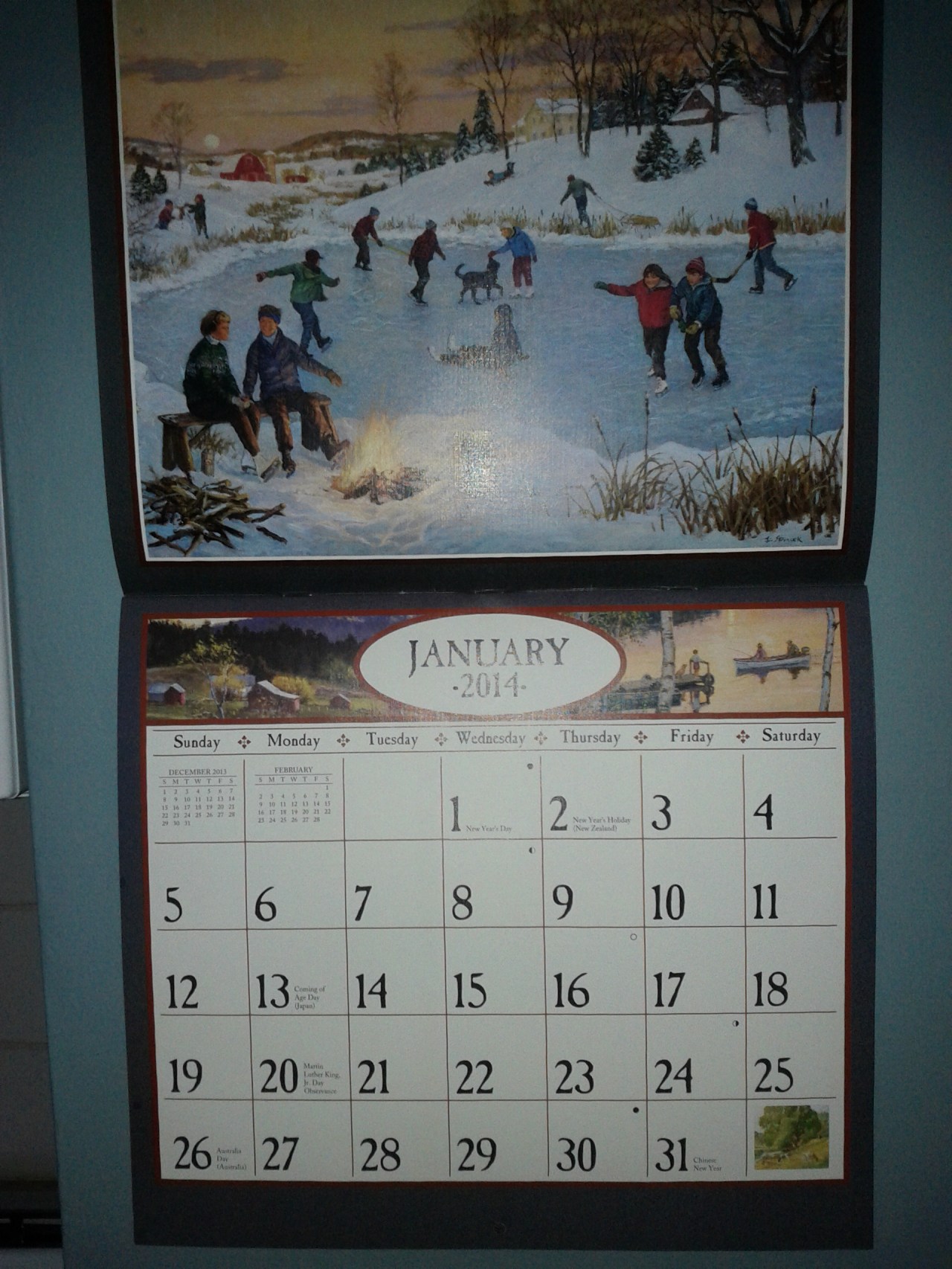
But right now it’s time for the official start of 2014. I put the old calendar in the recycle bin, and reach under the Christmas tree for the new one, a gift from my father-in-law. I settle it into place on the empty wall by the stove, and stand back to admire the uncluttered expanse of white January squares, and the painting of children playing in a snow-covered country clearing.  I wonder what the next 12 months will hold, what I’ll be thinking and feeling and remembering when I leaf through this calendar on January 1, 2015. No doubt there will be a few downward slides, and one or two spectacular tumbles. But, like the children in the image, I’m also hoping 2014 provides me with many opportunities for artful collaborations, cozy conversations with friends and family, and the discovery of unexplored paths. When it comes right down to it,  who could ask a year for more than that?

IMG_20140101_134959


December 19, 2013

IMG_20131211_075651Snowsuit unzipped, mittens dangling, the little blonde boy stands rooted in front of the shuttered travel agency’s red and gold dazzled Christmas tree. People balancing coffee cups flow around him on their way to work in the mall’s shops and offices, gifting him with indulgent smiles. His ponytailed mother leans against a pillar a few feet away, flicking through her messages. She pockets her phone and reaches for the boy.

“Come on, Darien, let’s go.”

Without looking at her, Darien shoulder feints and shoves his hands in his pockets.

“I said we have to go.  Right now. You’re going to make me late for work.” She digs for one of Darien’s hands, and he collapses in a heap on the floor.

“NO! NO! I don’t want to go! I want to stay here!”

“And I say we’re going NOW.” She picks him up, dodging his flailing arms and winter boots.  The last I see and hear of them is her grimly tired face and his protesting shrieks, echoing up the escalator.

I’m sympathetic to Darien – and to Darien’s mom. Christmas can have a similar effect on me. I want to stand still, to experience its sparkle, to drink in its wonder.  But Christmas realities – too little  time, not enough money,  conflicting priorities and expectations -can dim the glow and turn the wonder into wonder why. Conversations I’ve overheard in recent weeks – on the bus, in restaurants, in office hallways and elevators – tell me I’m not the only one feeling seasonal tension. “I  told the kids  we just don’t have the money for gifts this year”; “If she thinks she’s going to tell me how to run Christmas in my house again this year….”; “I can’t believe it. My daughter just e-mailed last night to say she’s not coming home for Christmas after all. She couldn’t even bother to pick up the phone. What kind of a Christmas are we going to have now?”

I’m also aware that some people are struggling with darker seasonal circumstances.  A father is dying. A wife decides she doesn’t want to be a wife anymore.  A son is in jail.   When our lives feel  anything but merry and bright at Christmas,  where do we find the courage to cope?

I discovered a few possible answers to that question in an unlikely source. At work the other day, I was browsing a publication from the Justice Institute of British Columbia. Its introduction discussed the values of the BC public service, listing courage among them.  When I saw the  six suggestions for courageous behavior,  and thought back to some of my own challenging Christmases, I realized I may have stumbled on some practical wisdom for those in search of ways to restore a little seasonal comfort and joy to their lives.

1)  Be biased toward action: This publication reminded me that we might feel more courageous when we take courageous action. We might not be able to change our less-than-ideal seasonal circumstances, but we can work on how we respond to them.

2)  Look beyond the process to see the possible: In the achingly beautiful song River,  Joni Mitchell’s response to Christmas decorations and carols is a wistful wish for  “a river I could skate away on.” When our mood doesn’t match other people’s cheerful preparations, it can be tempting to simply turn and run.  A writer colleague of mine does just that, reserving a hotel room in Victoria and spending Christmas by himself.  An alternative to retreating might be to stay put, looking past old Christmas processes to new possibilities. The year my marriage dissolved, I grieved the end of many Christmas traditions. But then, I began volunteering at the local youth emergency shelter. At Christmas, the shelter put out a call for stuffed animals to put under the tree for the kids who couldn’t go home. I spent hours in toy departments, conducting huggability quality control on plush bears. In the process, I forgot my own sadness for a while and hoped my gifts would help the youth to  put aside their sorrow as well, however briefly .

3) Apply imagination: A few days ago, I visited an office in downtown Edmonton where I was delighted to find a highly creative response to the building’s ban on live Christmas trees. It reminded me of how powerful  resourcefulness can be when obstacles threaten to take away the parts of Christmas we’ve grown to love.IMG_20131210_100648

4)Take thoughtful risks in generating and implementing ideas:  It can be scary to  leave behind Christmas traditions, even when  they seem to have outlived their value. Scarier still when those traditions are cherished by those with whom you’ve shared them. I’m thinking here of the young woman I mentioned earlier who informed her parents by e-mail that she wouldn’t be coming home for Christmas.  Initiating an honest conversation about the changes you want to make can take great courage.  But your thoughtfulness gives an opportunity for everyone to have some input into the decision and possibly come to an amicable compromise.

5) Empower others to take initiative, even in uncertain times:  Feeling sad or lonely or disappointed at Christmas can impede our ability to generate and implement ideas. But you don’t have to figure things out by yourself.   A trusted friend, a good colleague, or a professional therapist can help you to decide how to take courageous action.  Sometimes, asking for help is the first and bravest step  in making a change.

6) Pursue a vision for the future: For me, having a plan is a great source of courage and strength. When I’ve had difficult Christmases, thinking about how I’d  cope the next year helped me to feel a little more in control. I always hoped my circumstances would improve but sometimes I realized they may be the start of a new version of normal.  Whatever the future held, I felt better able to face it with a plan in mind. 

And so I wish you courageous Christmas. If your Christmas doesn’t require any courage, maybe you have a bit you could spare for someone who’s coming up short this year.  Your donation could be one of the most important and appreciated gifts you’ve ever given.

(Please note that I am not a trained psychologist. This advice is based on the methods that have helped me and  some of the people I know to cope with difficult circumstances at Christmas. If your situation is extremely challenging, please contact a mental health professional  for assistance.)