As we join the line to walk through the dimly lit exhibition space in the Hiroshima Peace Memorial Museum, a sign warns parents of the disturbing content, and cautions them to prepare children for what they’re about to see and monitor their responses.
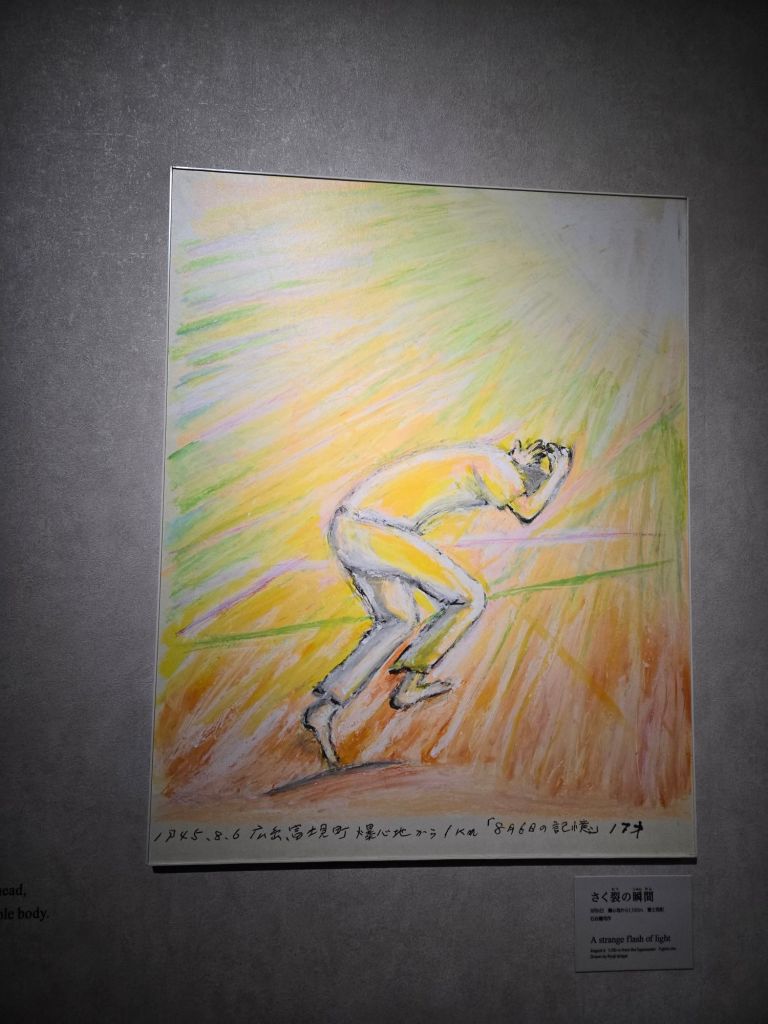
It’s good advice for all of us. I take only one picture, the first in a series of art depictions of and photographs taken on August 6, 1945. Then I put my camera away. Somehow, it doesn’t seem respectful to capture the other horrifying, heart rending moments of those whose lives were changed forever that morning.
Most visitors have made the same decision. As the line moves slowly along, and we lean in to look at the displays and their captions, the exhibit rooms are silent except for the occasional whisper or murmur. It’s not easy to look at the shreds of children’s clothing, their damaged school bags, a blackened, twisted tricycle, photographs of the horrifying injuries inflicted on people’s bodies by the atomic blast. Reading the survivors’ memories of what they saw and heard that day wrenches my heart: Parents looking desperately for children. The injured crying out for water.
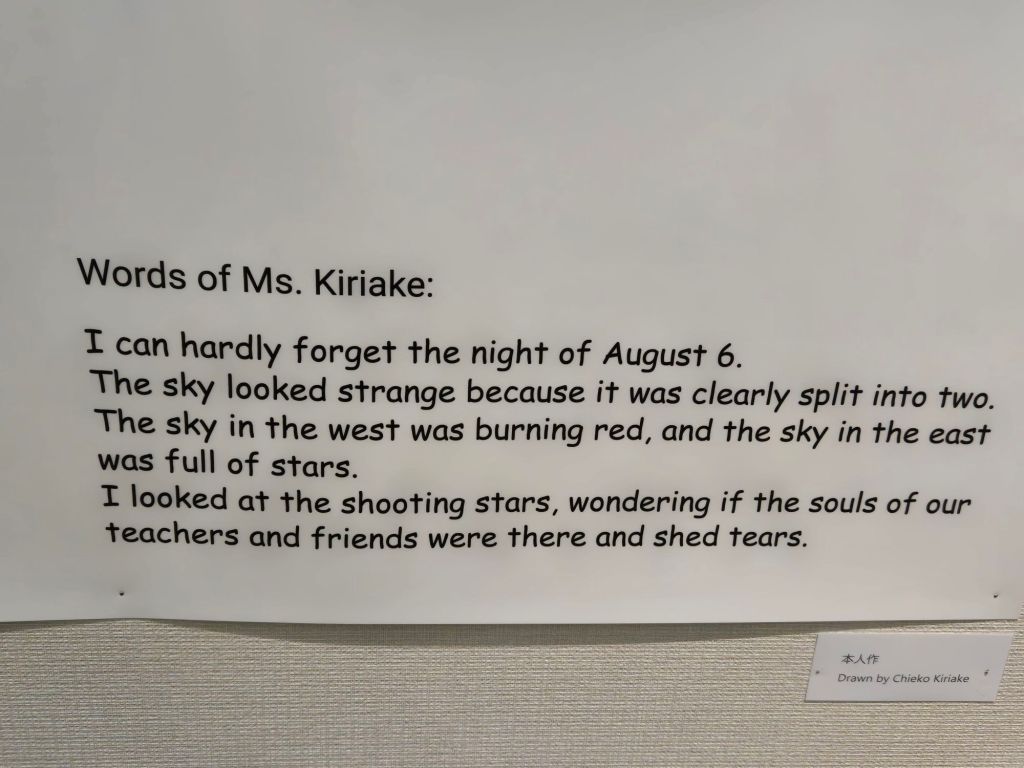
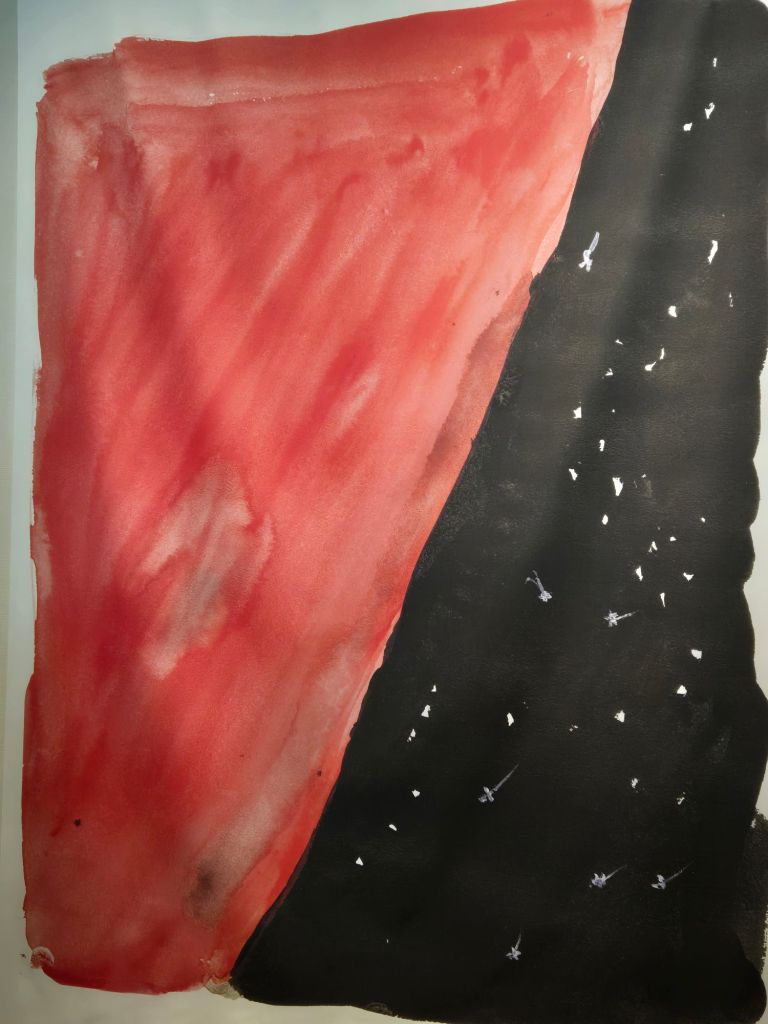
So many of the victims were children and their teachers, out early that morning clearing away the remains of already bombed buildings to make fire breaks in the event of other attacks. Those children who miraculously survived shared memories of the day in journal entries, interviews, and drawings. Chieko Kuriake, who was 15 years old, had these words and an accompanying painting to describe the sky that night:
I monitor my own responses closely as I view the exhibits. A few times, I step out of the line, unable to continue imagining the atomic bomb aftermath. I see a dad with his arm around his son’s shoulder. The boy, about the age of my 8- year- old friend Isaac at home, holds his dad’s hand, and a sob clutches my throat.
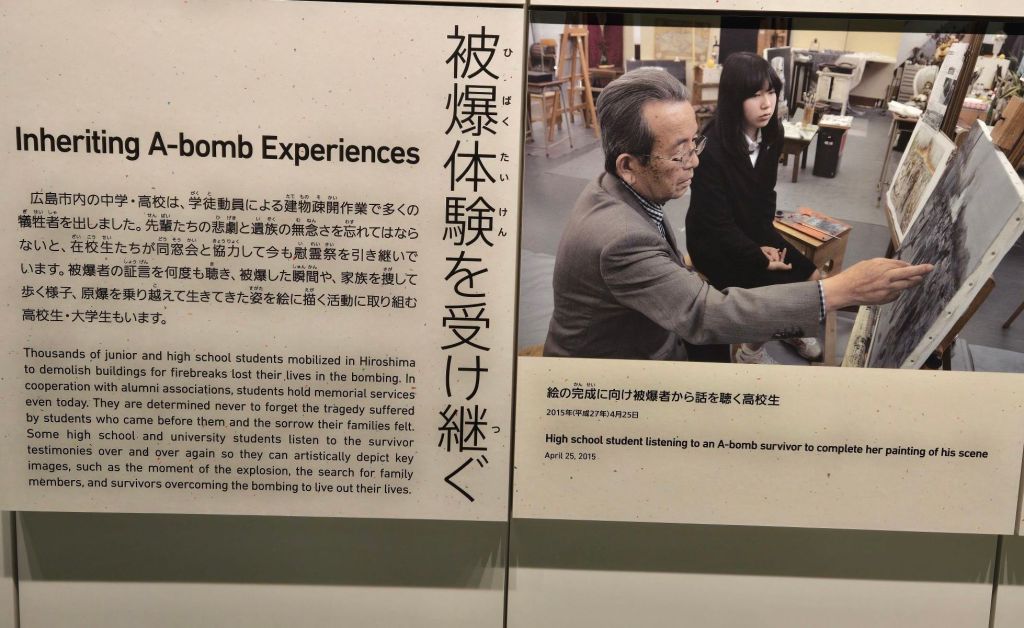
After we leave the exhibit area, there is a long corridor with floor to ceiling windows overlooking the Peace Park. Some people are sitting on benches, staring out the window. The father and son I saw earlier are having an earnest conversation. We wander the rest of the exhibits which focus on how the citizens of Hiroshima are preserving the memory of August 6 and trying to convince world powers to eliminate nuclear arms. As fewer survivors remain to tell Hiroshima’s story, high school students record their memories in drawings.
I’m glad that we are able to view the outdoor monuments in the Peace Park under sunny blue skies.
An inscription on the memorial cenotaph for the victims says it embodies “the spirit of Hiroshima – enduring grief, transcending hatred, pursuing harmony and prosperity for all, and yearning for genuine, lasting world peace.”
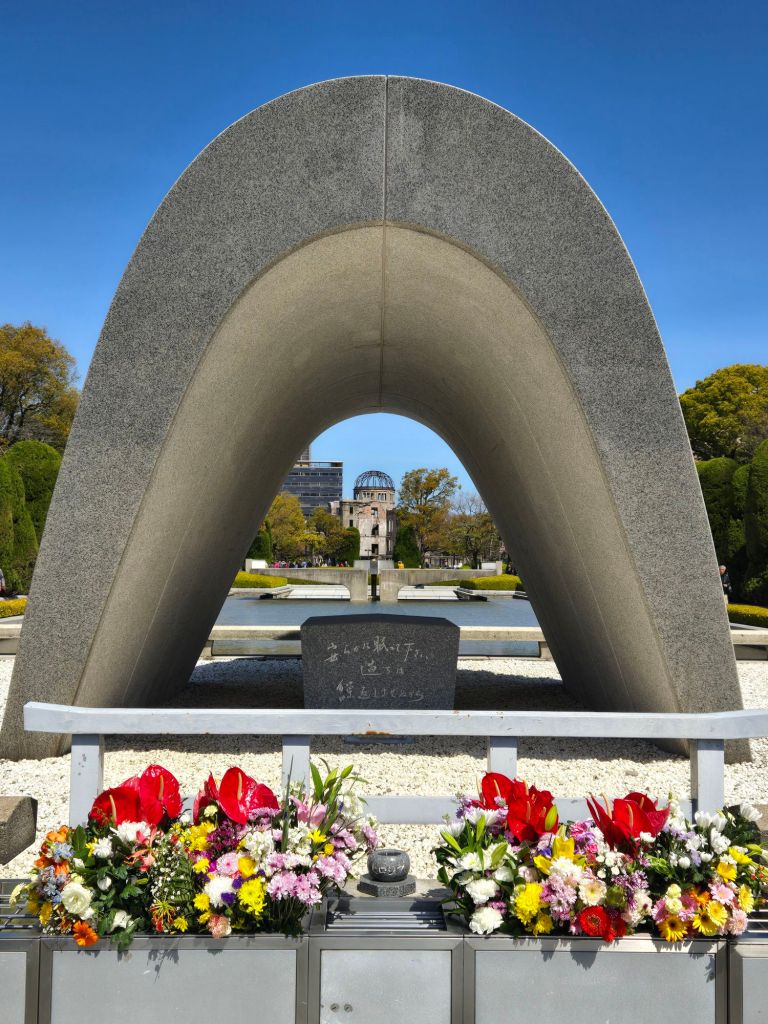
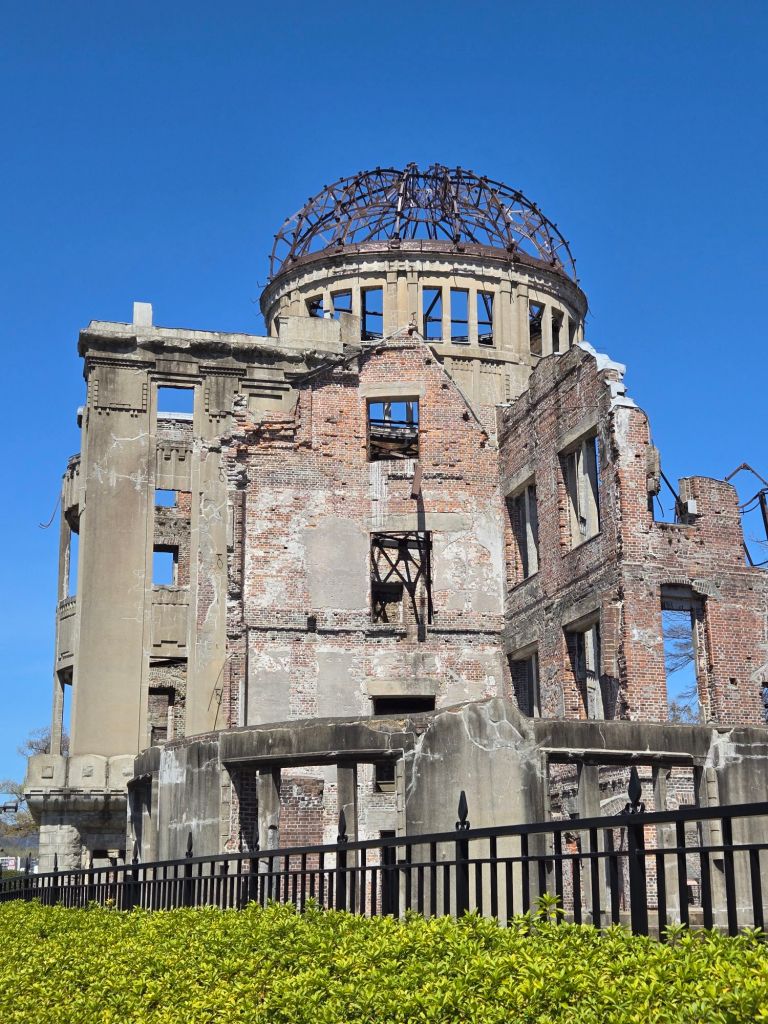
The cenotaph frames the remains of the Hiroshima Prefectual Promotion Hall, which was 160 meters from the hypocenter of the blast. This is one of the more controversial reminders of that day, with some residents calling for its demolition because of the painful memories it evokes. However, it was added to the UNESCO World Heritage list as a reminder of “the horrors of the atomic bomb and as a symbol for world peace.”
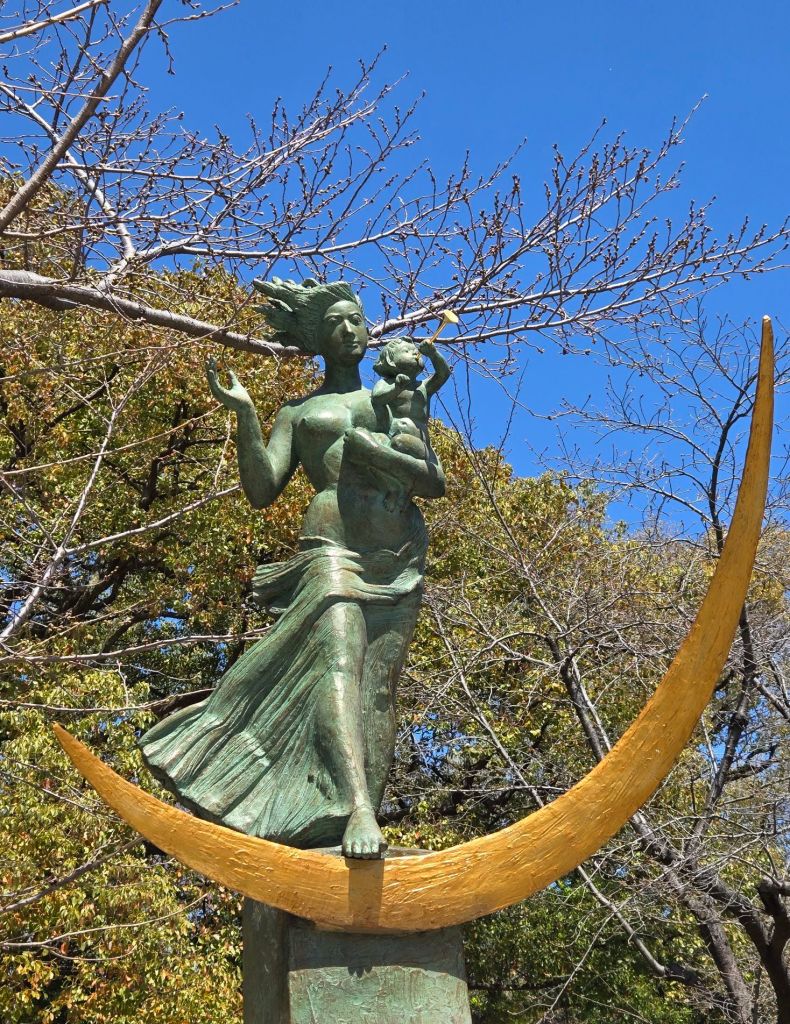
The Prayer for Peace Statue depicts a mother holding a child playing a golden trumpet for peace ” in the search for a new future, as a crescent moon becomes a full moon.”
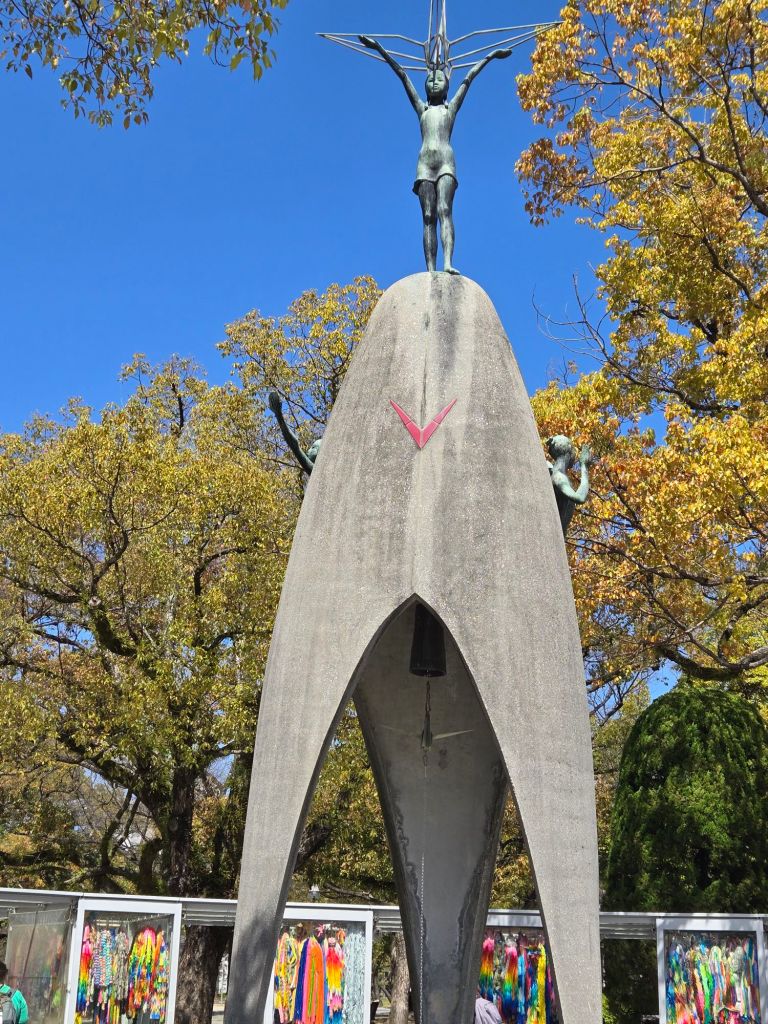
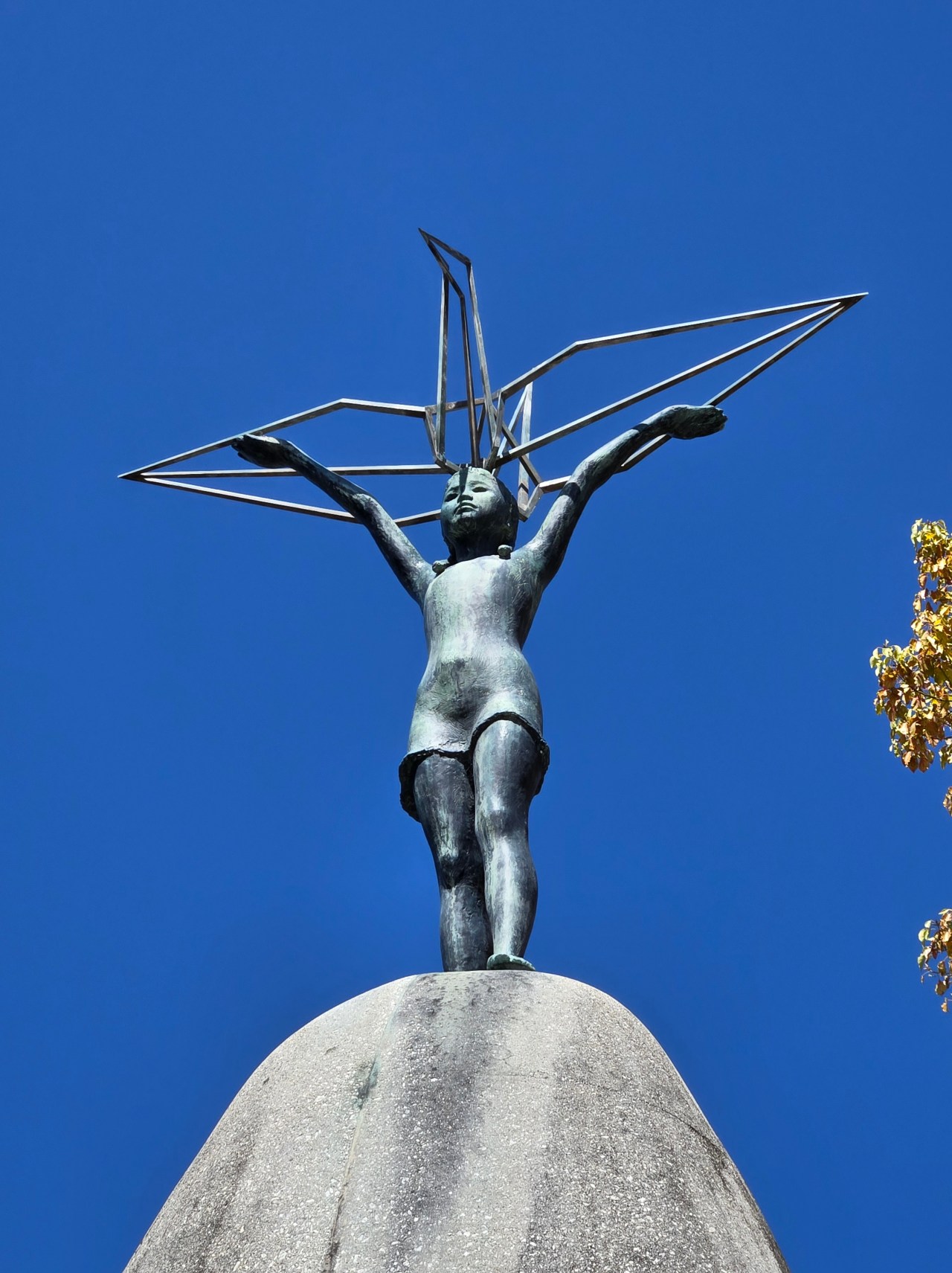
The Children’s Peace Monument, funded by donations from more than 3200 Japanese schools and donors from nine countries, honors all the children whose lives were lost that day and in the following years. At the top, a girl lifts a golden crane ” entrusted with dreams for a peaceful future.”
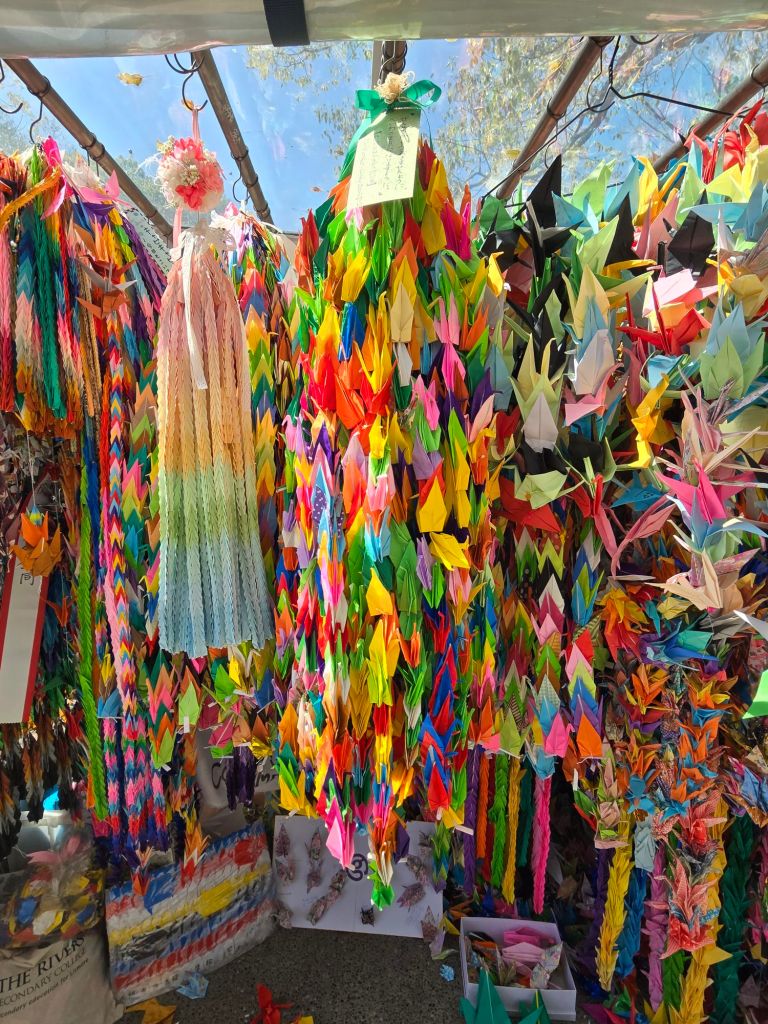
Under the monument in display cases, there are hundreds of strands of paper cranes, sent from around the world. A note of appreciation says how glad the Peace Park is to receive them as a symbol that people still remember Hiroshima’s grief and stand with the city in a call for world peace.
 Wise Woman Travel
Gives new context to the Oppenheimer story. It was even difficult for me to read this post.
LikeLike
The Oppenheimer movie opened in Japan to mixed reviews the day after we visited the museum. That the movie stopped short of showing the devastation in Hiroshima was criticized by some. The CBC app has that story.https://www.cbc.ca/news/world/oppenheimer-japan-debut-1.7159501
LikeLike
A sobering article. I so admire how the Japanese have overcome, and move towards a new future. The struggle you describe viewing the images reminds me of how I felt viewing drawings and poems done by young Jewish children who were detained in Prague. No one left with dry eyes.
LikeLike
Yes, the Holocaust museums evoke similar emotions – the horror of one country’s inhumanity to another.
LikeLike
I shared this with Todd. He’s been to Japan but he didn’t see this.
LikeLike
Thanks for the share with Todd, Ruth. He’s now following the blog. I’d love to swap Japan stories with him sometime.
LikeLike