Wise Woman Travel

Exploring the world from a female perspective

John Pierpont Morgan has been called the most influential financier in U.S. history. Between 1890 and 1913, his company was instrumental in the establishment of 42 major corporations including General Electric, International Harvester,  AT & T, and the Atchison Topeka Santa Fe railway. He financially backed countless projects, including Thomas Edison’s Edison Electric Illuminating Company, as well as the editor who wanted to prop up the then-struggling New York Times.

So it probably comes as no surprise that the phrase “If you have to ask the price, you can’t afford it” is popularly attributed to JP Morgan. His home on Madison Avenue was the first private residence in New York to be lit by electric lights. He owned several yachts,  and amassed such an extensive array of rare books, art, antiquities, and manuscripts, that he had a private library built next door to his New York home. Its stunning architecture was intended to provide sumptuous surroundings for the prestigious collection and to impress the wealthy guests who were invited to the Morgan household.

In 1924, 11 years after Morgan’s death, his son JP Morgan Jr., transformed the library into a public space, making it one of the largest gifts of cultural artifacts in U.S. history. For $20 US dollars, you can wander through the library, soaking up its elegance, marvelling at the vastness of the collection. It’s not hard to imagine JP Sr. himself relaxing in front of the fireplace in his office, smoking an expensive cigar and sipping fine brandy, while his private librarian shelved Morgan’s latest acquisition.

A short walk from the Morgan Library’s hushed opulence, you’ll find a library of a different sort – the buzzing main branch of the New York Public Library. It covers two blocks on 5th Avenue, and has holdings of more than 53 million items, making it the second largest library in the U.S. and the fourth largest in the world. Established in the same “era of elegance”  as Morgan’s private building, it has some similar breath-taking architectural features.

The one difference is that these features, and everything else in the Library, has always been accessible to all members of the public, attracting New Yorkers and out-of-towners alike. The spectacular Rose Main Reading Room is open to everyone, its interior lit by enormous chandeliers and windows, its ceiling a mural swirl of clouds and sunny blue, suggesting that the sky truly is the limit for those who read here.

DSCN3830

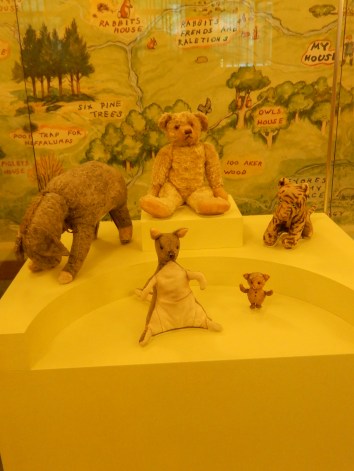
DSCN3842 But the library is not intended only for serious adult patrons. The charming children’s room features a stimulating space for little readers and their caregivers. They can even visit Christopher Robin Milne’s original stuffed animal collection – Winnie-the-Pooh, Kanga, Piglet, Eeyore, and Tigger – the inspiration for the classics by Christopher’s father, A.A. Milne. DSCN3836

There is, of course, no admission charge at the New York Public Library. Twice daily docent-led tours are free – but get there well ahead of their start times because the day that my friend Angela and I visited, the tickets were all gone by the time we arrived. Not only that, but only one audio guide remained. “We’re thrilled, if a little surprised, to have so many people visiting,” one of the women at the service desk said.

Never mind.  Welcome, access, inclusion – that’s what public libraries are all about.


Tonight we honor what was lost, but we also commemorate what we found.

                                    –Come from Away, April 2017

After watching in horror as the twin towers burned, after doing my best to reassure anxious students when I wasn’t feeling so calm myself, I found the nearest computer and e-mailed my friend Angela in New York City. Her return message came quickly: “Yes, we’re OK. Thanks for checking. Others not so lucky.”

I visited New York City twice after the 9-11 memorial opened for public viewing, but couldn’t bring myself to go there either time. I only went this trip because a friend had told me, “You should go. It’s not as awful as you think. It’s actually kind of peaceful.”

She was right. The Easter weekend crowds were respectful, parents quietly explaining the memorial to children who had never seen those long ago television images. The double footprints of the towers are now filled with water flowing inward, the surrounding stones inscribed with the names of those who were lost. Here and there, a white rose, signifying that today would have been someone’s birthday.

For some of the New Yorkers we’ve been meeting, the memories of that day are still painful. Our young tour bus driver’s voice quavered when he talked about it. The gregarious host of a walk we took through Greenwich Village said she still hadn’t been to the 9-11 Museum. “I couldn’t bear to hear their voices, “she said.

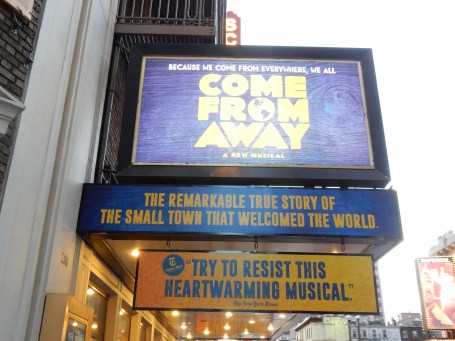
DSCN3662But there are 16 voices associated with the tragedy that New Yorkers are not only listening to but celebrating, embracing, coming back to hear again and again. They are the cast of the Canadian musical Come From Away, which depicts the kindness and generosity extended by the residents of Gander, Newfoundland, to almost 7000 airline passengers whose planes were forced out of the sky on September 11, 2001. The play is based on thousands of hours of interviews with the Newfoundlanders and the “come from aways” – how they coped with the five days they spent together, and how they changed as a result of their interactions.

Through music and song, the play details the townspeople pulling together to provide places to sleep; plentiful and appropriate food for everyone, including Jews, Muslims, and vegetarians; language translation; pet care; telephones; and generous helpings of compassion to people who a few hours earlier had been on their way to somewhere else.  No problem was too large to be solved, no detail too small to be overlooked.

The stories of individual heroes – from the town and from away – showed the deep wells of  strength, good will, and humor that people tap into under adverse circumstances. Beverly Bass, American Airlines’ first female captain, had been piloting a 777 from Paris to Dallas when she was ordered to land in Gander, unsure whether the airport conditions could handle a plane of that size. Bonnie Harris, the manager of the Gander SPCA, demanded and received access to the airplane holds, scrambling over suitcases to find and care for dogs, cats, and two chimpanzees – one of them pregnant. A team of cardiologists on their way to a conference stepped up to clean the washrooms at the local school where hundreds of people were bedded down in the gymnasium.

The five days also brought unfolding tragedies. A New York City woman left message after message for her firefighter, none of them returned. A gay couple was torn apart when one man, devastated by his separation from his Brooklyn family, accused his partner of indifference to his grief. An Egyptian passenger faced violence when his Arabic telephone conversation was misinterpreted as a potential terrorist message.

The play’s final moments depicted touching farewells, promises to stay in touch, and suggestions of new romance, followed by the joyous 2011 reunion between the Newfoundlanders and the plane people. Perhaps the best lines of the closing act occurred between the woman who had lost her firefighter son, and the Gander schoolteacher whose compassion, friendship, and humor continued to be a source of strength.

“Why can’t you ever tell a Newfoundlander a knock-knock joke?” said the NYC woman.

“No idea,” said the Gander woman.

“OK,” said the New Yorker. “You be the Newfoundlander, and I’ll tell you a knock-knock joke.  Here goes: Knock knock.”

To which the Gander woman replied, “Come on in. The door’s open!”

To learn more about the Come From Away story, including footage filmed in Gander at the time of the original events, go to comefromaway.com/learnmore.


Growing up in 1960s Edmonton, Alberta, where single family dwellings were plentiful, and back yards were a part of most childhoods, it took a trip to New York City in the mid-1990s to remind me that not every kid had access to lawns, gardens, swingsets, and next-door-neighbor friends.

My friend Angela introduced me to the term “play date,” which I found very pretentious until she explained its necessity: in the apartment culture of New York, where children have to be accompanied to outdoor play spaces, outings between young friends have to be planned, timed, and carried out between their parents.

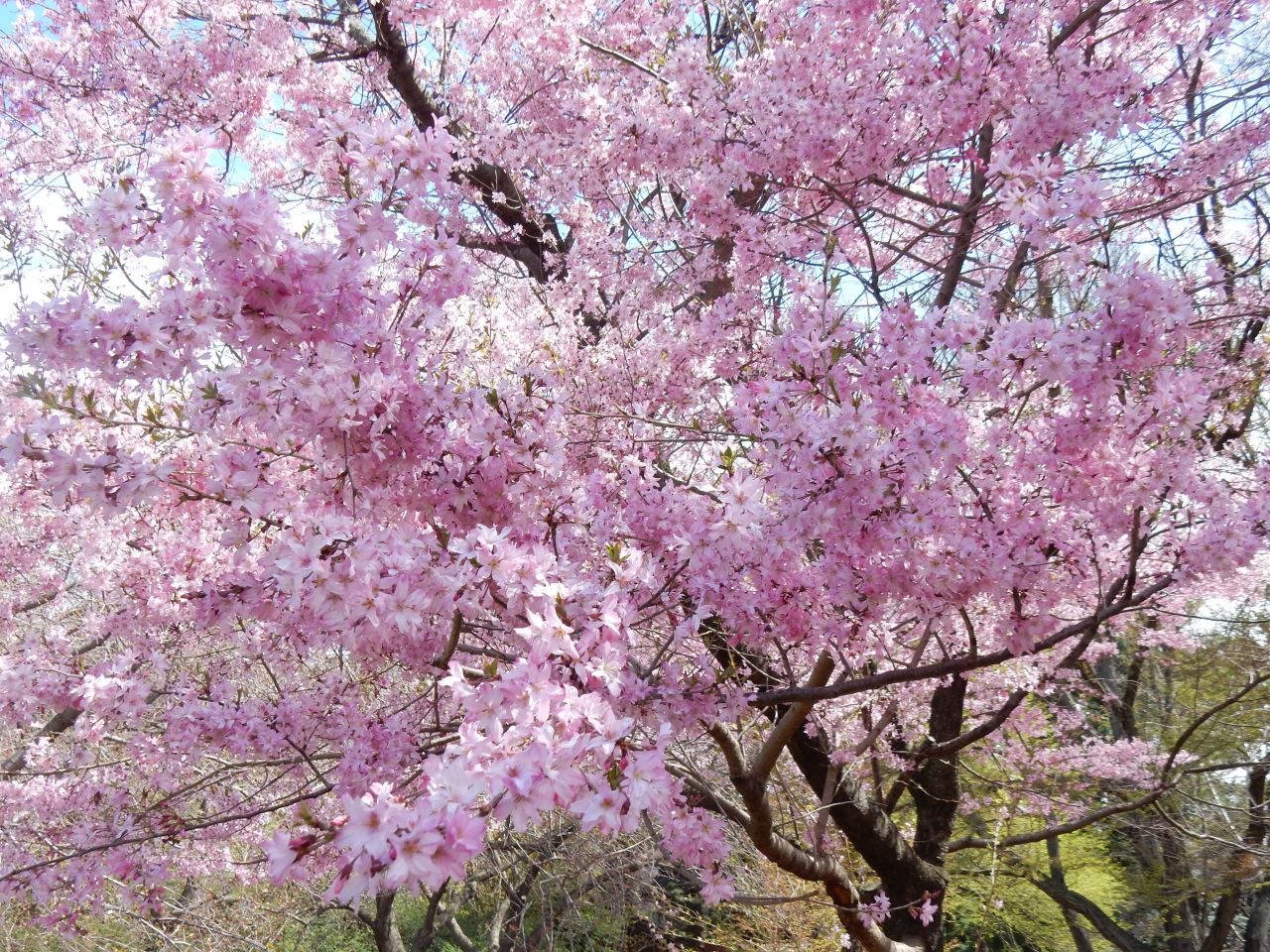
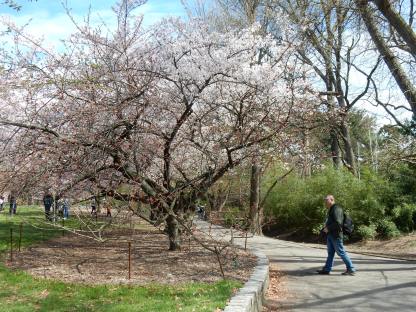
I was reminded of this necessity on Good Friday when we visited the Brooklyn Botanic Garden,  a 30 minute subway ride from our hotel on the Upper West side of the city. I had been on cherry blossom watch via the Garden’s online map since before we left Edmonton, and it looked as though we were in luck. Although not all the trees were putting on a show yet, enough of them were blooming to make our trip worthwhile.

Of course, a sunny holiday Friday meant that lots of other people were arriving to enjoy the blossom spectacle. But unlike so many other places in NYC where crowds diminish the experience, the Garden has a less popular reputation and enough space that it can peacefully accommodate little kids running around, parents wheeling strollers and sipping take-out coffee, and elderly couples meandering along, with no one getting in anyone else’s way.  DSCN3593


Dozens of different varieties of cherry tree grace the Cherry Esplanade, their blossoms ranging from hot pink to pastel to white, their branches sturdy and skyward-reaching, or cascading wispily on slender limbs. Lining the edge of the Japanese Pond and Garden are the weeping cherries, some of the oldest trees in the collection.

Like any other garden tour, this one can take as much or as little time as you care to spend. But I notice that no one seems to be hurrying towards the exit, a testament to the importance of these lovingly maintained, tranquil oases, and their calming influence on urban lives.


The first time I visited my friend Angela at her home in New York City, I asked her what she liked best about living in the city that never sleeps.

She didn’t hesitate. “Its acceptance of everyone,” she said. “It doesn’t matter who you are, where you’re from, who you worship, who you love: New York has a place for you. No idea is too strange, no dream too outlandish. New York is always going to be the place that welcomes you to take your best shot.”

Maybe that’s why I’ve always enjoyed my trips here. Excitement and potential pulse along every street. A spring visit – when nature stubbornly reasserts itself in every crack and crevice of the concrete jungle – seems especially full of promise. New Yorkers are out and about, filling up every sidewalk table, bustling home with bouquets of tulips from the green grocer, finding parks where their children can run free after a long winter of apartment discontent.

This visit, I’ve felt particularly inspired by New York’s “anything is possible” spirit. On the cusp of a major career decision, my ideas for new initiatives seem to flow more freely here than they did at home, to have more potential. I wonder how many other people have heard New York whispering, “Go ahead. Give it a try. What have you got to lose?” DSCN3572

“We were together. I forget the rest.” (Walt Whitman)

If I were asked to use one word to describe the faculty where I work, “diverse” would pretty much capture us. Every day, international and Canadian-born students and staff come together to learn, to teach, to research, to administer programs, to provide security, and food, and cleaning services. Because we’re located in Edmonton’s rapidly changing downtown core, we mingle with the general public – some of them visiting the public library, which shares our building; others cutting through to access nearby restaurants and shops, still others just hanging out, looking for a warm and welcoming space to spend their time.

Like all communities, we have days when our complex and sometimes competing needs and priorities overwhelm our best attempts to get along, when faulty assumptions, miscommunication and misunderstandings put us at odds with each other.

Today was not one of those days.

20170126_120839In honor of the lunar New Year – we have many students from China studying in our faculty, and people of Chinese heritage make up seven per cent of our city’s population – we gathered in the atrium of our building to eat, play games, make decorations, and talk. A visiting Uruguayan professor introduced his wife and daughter to one of our Argentinian-born instructors, who had brought her daughters to enjoy the fun. Students from Africa and Japan crafted paper lanterns together. A husband and wife from Kazakhstan, enrolled in English language classes, chattered in Russian and giggled as they tried to pick up marbles with chopsticks.

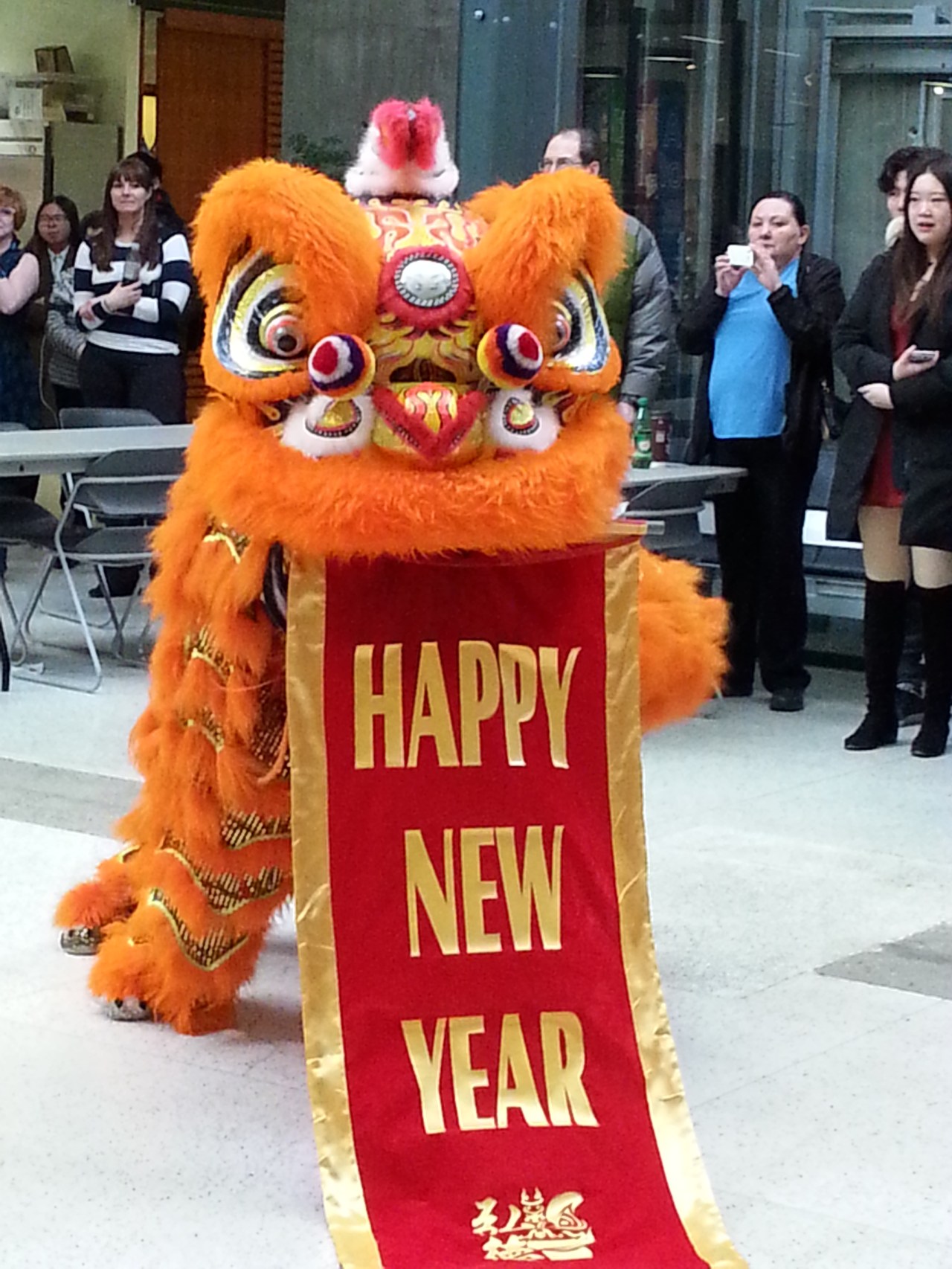
Suddenly, all our conversations were drowned out by raucous drumming, clashing cymbals, and the appearance of two dancing lions. A little girl shrieked with delight as one of the lions paused in front of her for a pat. A group of Indigenous students abandoned their tables and their pizza to capture the spectacle on their phones. The rest of us craned our necks for a better view of the lions’ antics, one moment whirling with gaping mouths to face the crowd, the next fluttering their gigantic eyelashes, the next butting heads in mock challenge of each other.

At last the drumming reached a crescendo and the lions unfurled banners wishing us all a happy new year. Our applause followed them as they danced away. “I’ve seen a lot of lion dances in this building over the years,”sighed one of the English language instructors, “but that was the best one ever.”

In ancient Chinese culture, lions were viewed as powerful and wise animals, able to chase away evil, and make way for happiness.  Judging by the way we lingered together after the celebration, still enjoying each other’s company, maybe we had all been reminded that, in spite of our differences,  those lion-like qualities live in each of us. We just need to let them out to dance a little more often.


The elderly man sitting in front of me in the tundra buggy leans over and says quietly into his wife’s ear, “How much longer until we see some polar bears?”

She points to the horizon, where another tundra vehicle filled with tourists is trundling up a hill. “I think that’s where we’re going, dear, so it might be a while yet.”
dscn3385

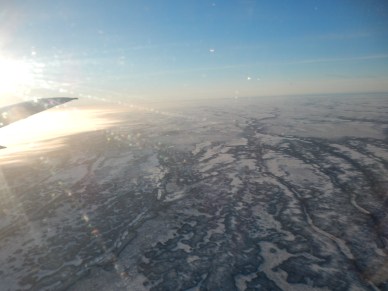
Our buggy driver Jim wasn’t kidding when he said that polar bear watching is not for the impatient. At 6:30 this morning, we joined 118 fellow travellers for a two-hour charter flight from Edmonton to Churchill, Manitoba, a community of 900 people perched on the western shore of Hudson’s Bay. A fleet of buses then took us 20 minutes down the road to the parking lot of Tundra Buggy Adventures, where we were sorted into groups of 40 and ushered on board the heated vehicles. Jim, our bearded, storytelling, driver and guide, schooled us in polar bear watching protocol – no flash photography out the windows, no eating or drinking on the outdoor observation deck, no loud noises when polar bears were in the vicinity, no hogging the best vantage points for photographs.

“And don’t forget you’re my eyes while I’m driving this thing. I’ll be too busy keeping us out of the ditches, so if you see a bear, use the o’clock system to let us all know where to look and I’ll do my best to stop.”
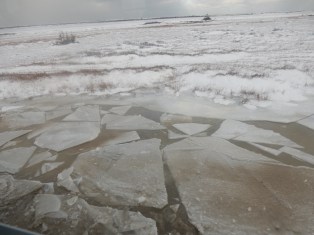
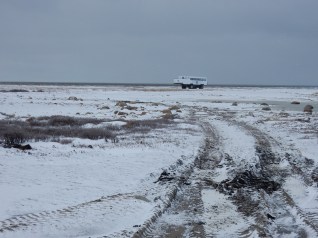
dscn3391

dscn3461

We start out on what Jim called the “super highway” – a relatively flat, smooth stretch of terrain that lasts only a few hundred meters. After that, we slow to a glacial pace, bumping over rocks and frozen mud ruts, breaking through iced-over dips in the road. Sometimes, Jim advises us to “get a leg out into the aisle”as the uneven terrain pitches the buggy precariously over to one side. We stare out the windows, scanning the horizon, but there really isn’t much to see except a black and white study of snow, stones, and clumps of willow shrub.

“8 o’clock!!!”
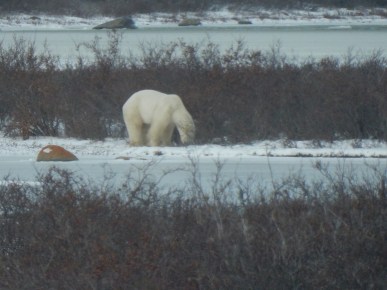
dscn3394

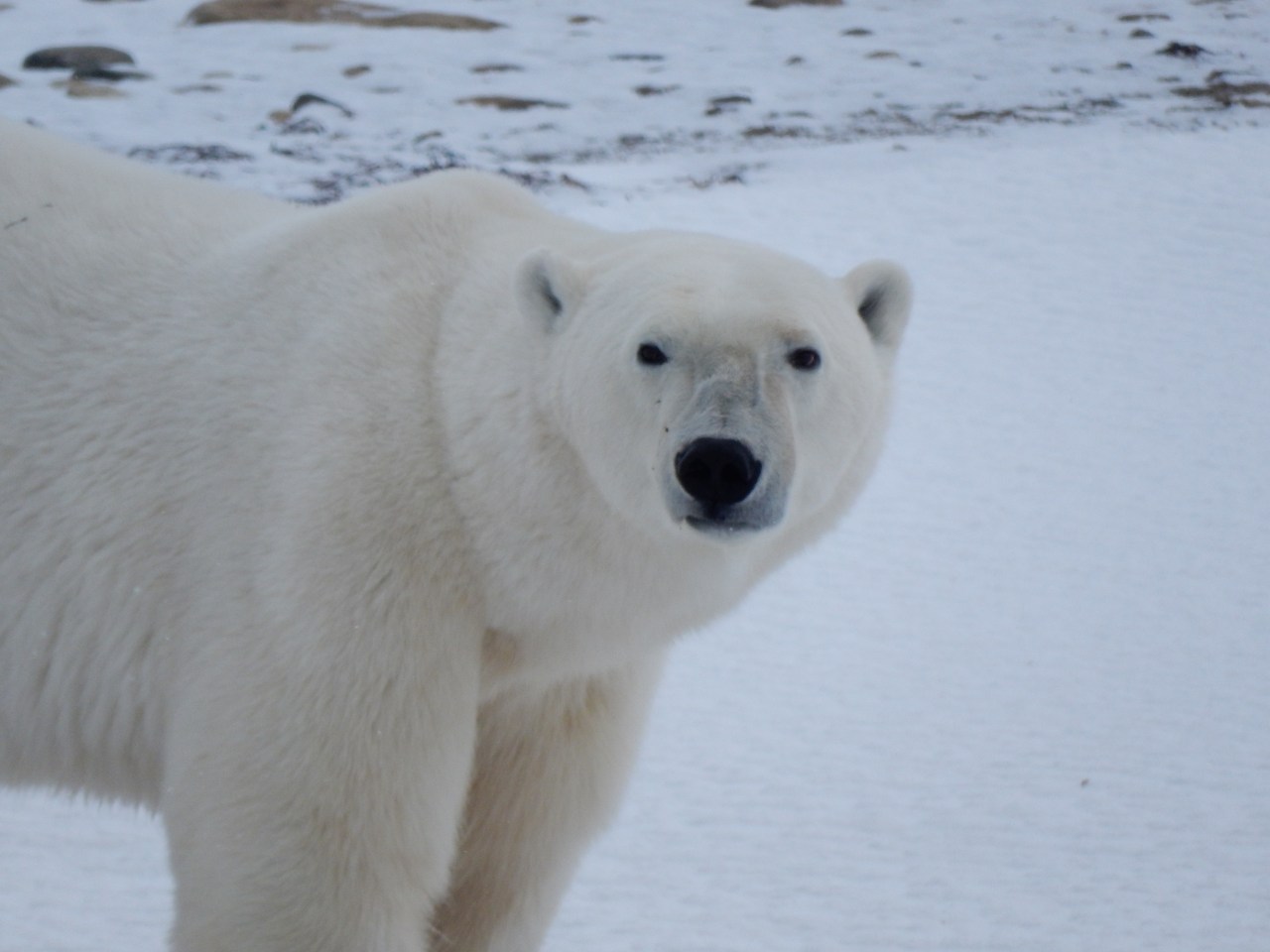
What? Where? All eyes pivot to the back of the bus, and we squint in the direction our fellow passenger is pointing. Rapid but quiet scramble to the outdoor observation deck as one by one we spot the white shape, head down, ambling beside a distant willow clump. He doesn’t hang around long, though, disappearing from view almost before you could say telephoto lens, much less get one trained on him.

We settle back into our seats, our appetites whetted by this early sighting. It isn’t too much longer before we see more movement, this time out of photograph range – a mother and cub, travelling together, and a lone male bear well behind them, but heading in the same direction. The cub suddenly takes off along the shoreline at a gallop, while its mother rounds to face the male, who immediately retreats.

“That’s a good mom, good instincts,” says Jim. “They’re not all like that. I remember seeing a young sow with a cub a few years back. She passed right by a male, didn’t even look around. A few minutes later, the male attacked the cub, killed it. Nature isn’t anything like Walt Disney.”
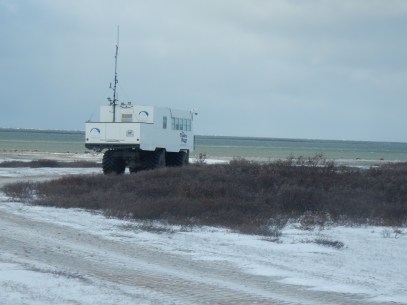
dscn3393

Half an hour passes with no more bears in sight. Jim taps into the radio chatter between the other buggy drivers and decides we’ll head over to Polar Bear Point, where Tundra Buggy Adventures has its lodge, a four-trailer, overnight accommodation for those who want more than the one-day version of the tour we’re taking. On the way, we pass Tundra Buggy 1, which is owned by Polar Bear International, an organization designed to “conserve polar bears and the sea ice they depend on.” Unlike us, they track the movements of a few polar bears all day, operating a live webcam that can be accessed around the world. “We want people to care about polar bears,” says Jim, “because you can’t care for what you don’t care about.”

Judging by the number of tundra buggies congregated near the lodge when we finally arrive, we figure there have to be polar bears close by. And then we see them, right next to the road – four males lounging around in the underbrush. They appear to be moving about as fast as we had for most of the morning, so Jim decides this would be a good place to park for lunch. We settle in with our soup and sandwiches to see what interactions might occur between the bears.

Unlike us, these guys haven’t eaten for four months, and won’t until they can get out seal hunting on the Hudson Bay ice, so it’s no wonder they’re lethargic. But then two of them sit up, nudging muzzles, showing off their tonsils, and generally trying to get each other’s attention.

Photo credit: Lorne Dmitruk

Photo credit: Lorne Dmitruk

Photo credit: Lorne Dmitruk

And then, like a pair of rambunctious teens, they begin to spar, a friendly behavior that will turn much more aggressive in later life when as older males they begin competing for female attention.

After the show is over and the bear buddies amble off, Jim starts up our buggy and weaves through the other parked vehicles to see who else might be hanging around the shore. I’m glad when someone across the aisle from me asks the question that had been on my mind ever since we’d arrived: with all the buggy traffic, could we actually be bothering the bears, rather than just observing them?

Jim says that one study had shown about 5% of polar bears display a negative response to the vehicles that lumber through their territory. “You might not realize it, but we’re actually in kind of a reverse zoo situation here. We’re the ones in the cages, and the bears decide if they want to be bothered to take a look at us.”

The last two bears we see prove his analogy. We pull up within a few metres of one who is snoozing with his paw over his nose. We stay there several minutes, but he never moves. Only when Jim starts up the engine does he slightly open his eyes, as if to watch our departure.

Just a little further down the road, we park behind another tundra buggy, its observation deck full of people pointing across the tundra. Coming towards us at a slow but determined pace is a large male, clearly interested in taking a closer look at us.

He hangs out for several minutes before deciding that we’re not that interesting. Shooting us a couple of backwards glances, he heads off across the ice, and disappears.

I wish him, and all the other bears we’ve seen today , a safe and productive winter. We’ve heard some sobering information about polar bear habitats. As global warming continues at an unprecedented rate, the ice which provides hunting platforms for the bears is dwindling. Ringed seals, the bears’ main food source, are also in shorter supply as their snow-covered birthing lairs are more frequently collapsing from overly warm winter weather, or being washed away by rain. Without seal fat in their bodies, polar bears are not only prone to starvation, but the females are less likely to give birth. Jim told us that in the years he’s been a buggy driver, he’s seen fewer and fewer bears in the Churchill area.

So what can we do to increase polar bears’ chances of survival? Visit the Polar Bear International website for a long list of ideas, from adopting a bear to lobbying governments to take action against climate change. Scientists now know that human activity has negatively impacted the polar bears’ habitat. But if we act quickly, we can also reverse some of the damage, and ensure that future generations can experience the awe of flying to Churchill and interacting with these Lords of the Arctic.

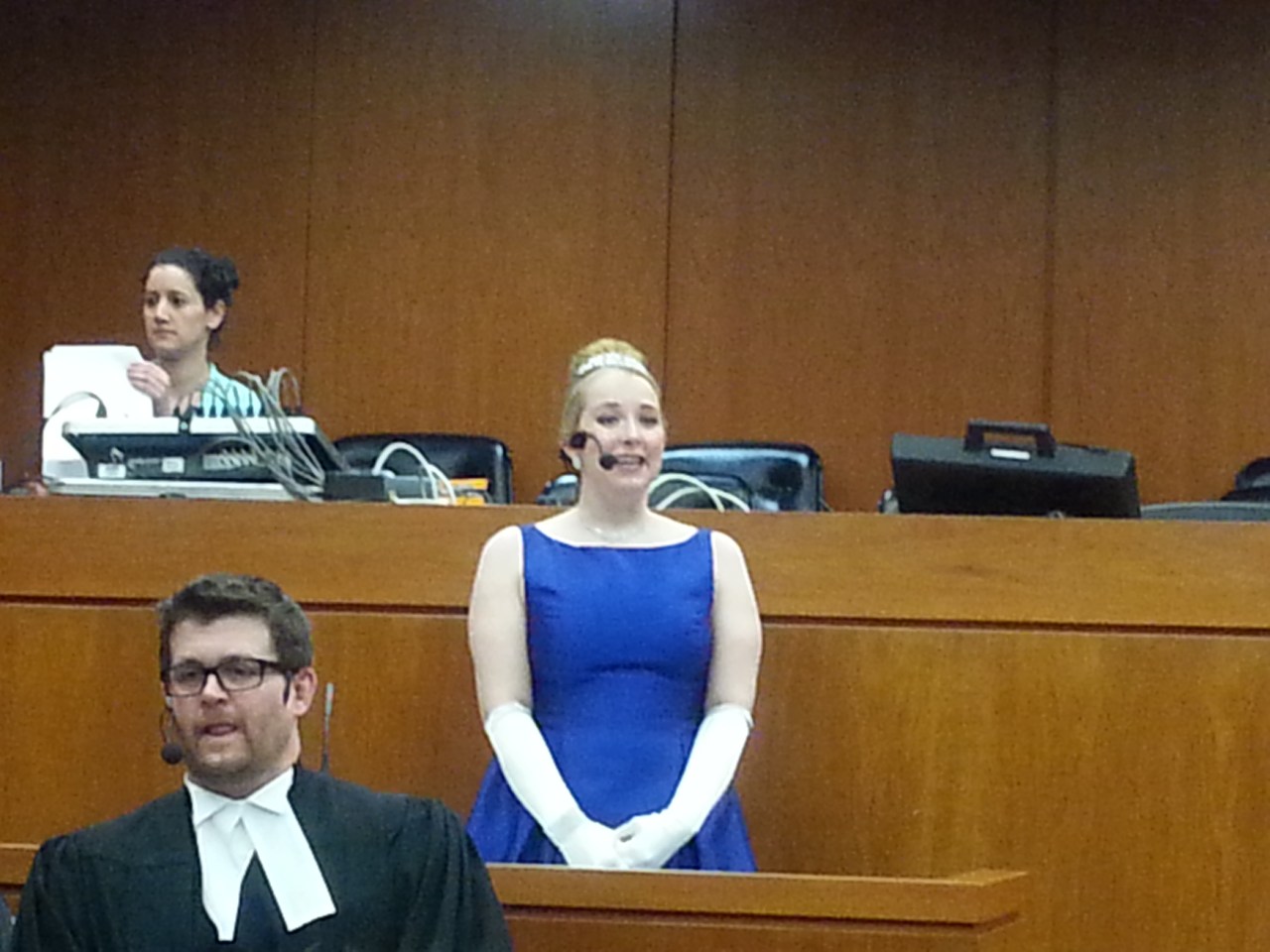
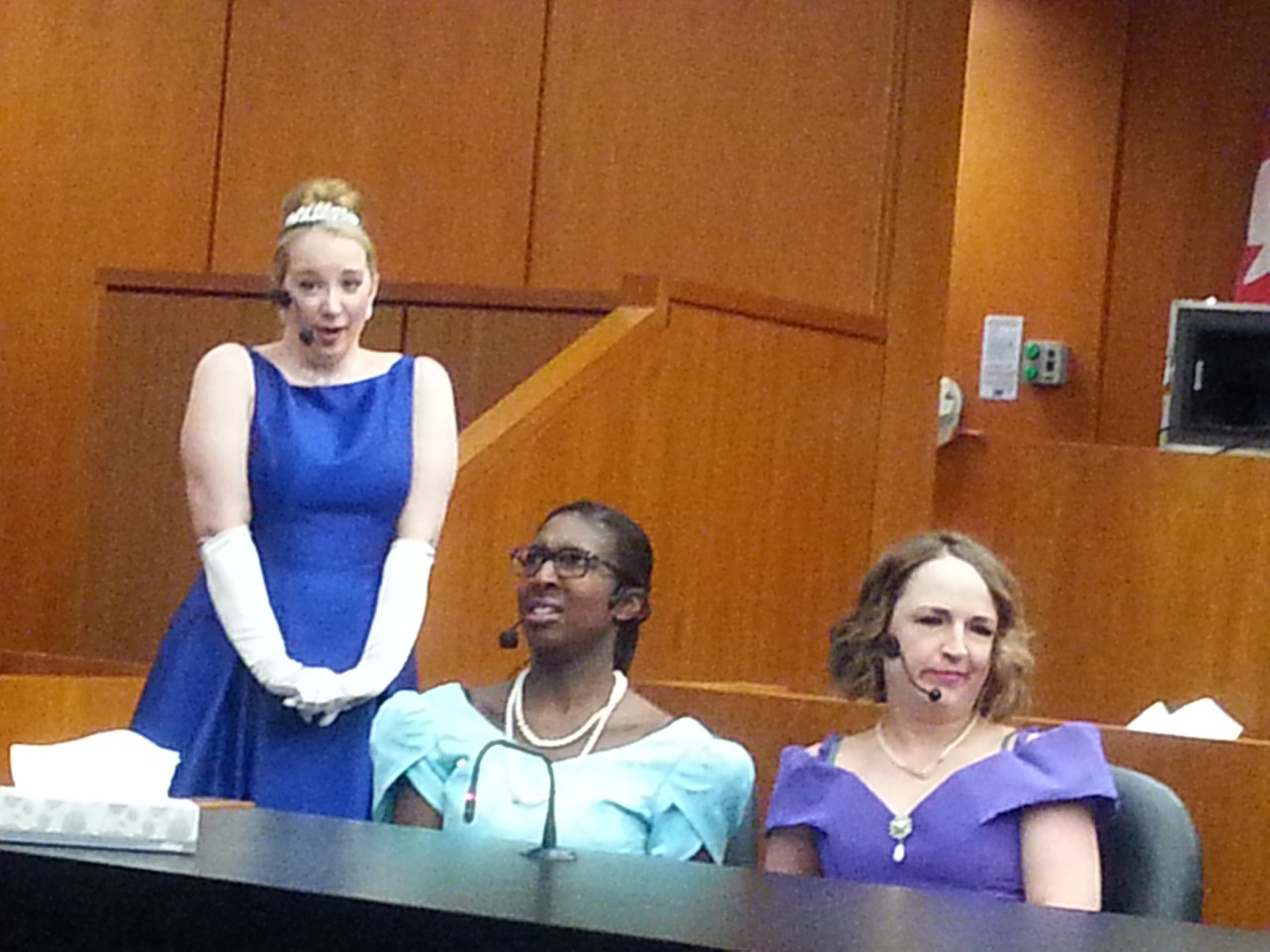
The black-robed lawyer paces as he cross-examines the wide-eyed young woman, resplendent in royal blue satin gown and elbow-length evening gloves, a glittering tiara sitting on top of her swirl of blonde hair.

“Now isn’t it true that you didn’t ever complain about the work your stepmother asked you to do? That you actually learned valuable skills from all that cooking and cleaning? And perhaps you’d be so good as to tell the court about your present circumstances?”

“Oh, I live in a castle with my one true love, Prince Charming,” offers the woman, beaming.

“Then why are you here today, asking your loving stepmother and stepsisters to compensate you for work from which you’ve obviously profited?”

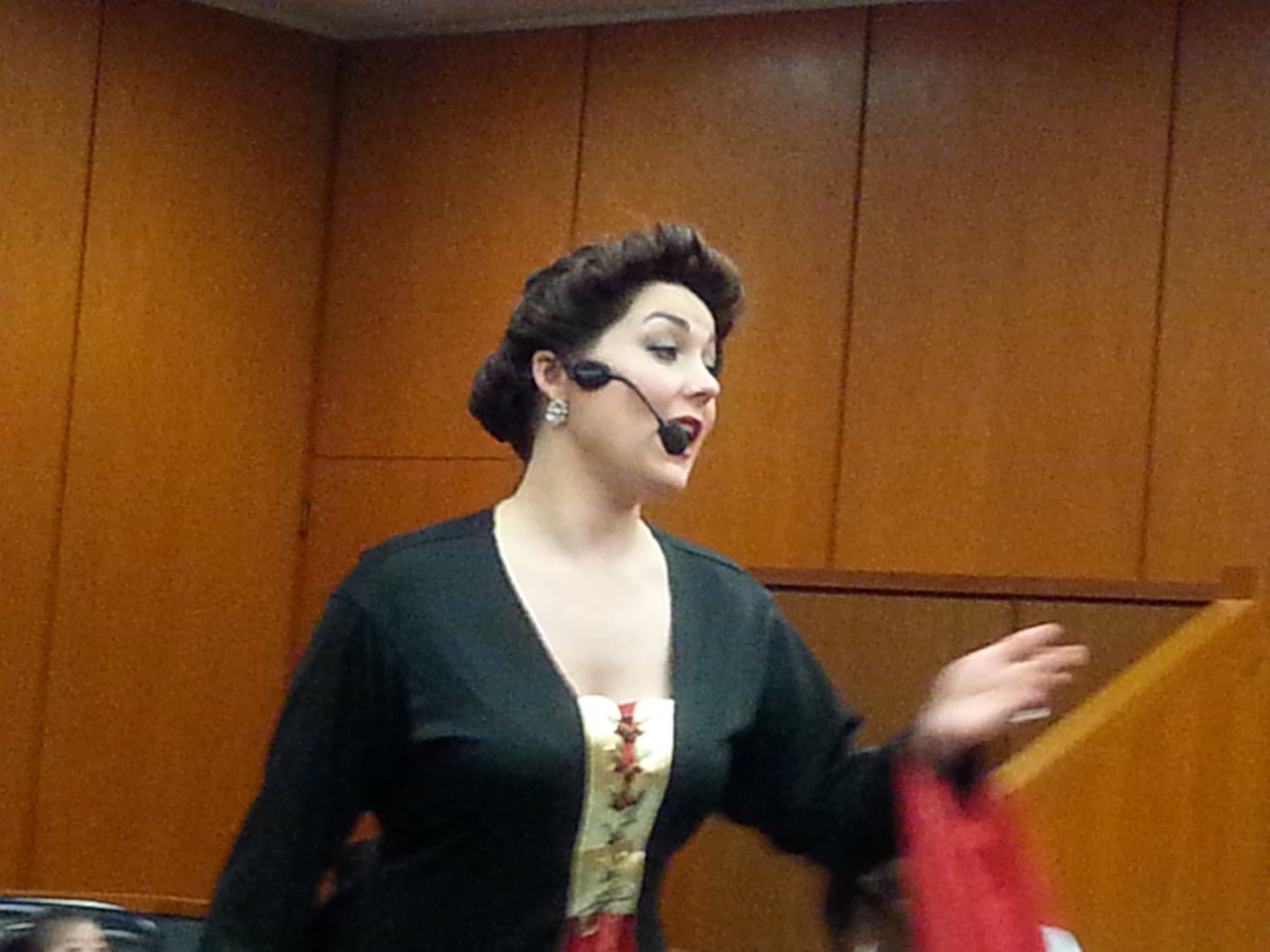
Pop music suddenly fills the courtroom. The young woman moves out of the witness box and belts out “Pay Me, OK?”, set to the tune of Carly Rae Jepsen’s  “Call Me Maybe”  as her stepsisters look on in disgust and disbelief. 20160416_101438(0)

So begins Cinderella vs. Lady Tremayne et al., the first of several mock trials at the Edmonton iteration of Alberta Law Day. Every April, in cities throughout Canada, the general public is invited to visit their local law courts to celebrate democracy and the 1982 signing of Canada’s Charter of Rights and Freedoms.  Displays, talks, tours, and mock trials are designed to help people learn more about the law, lawyers, and the judicial process.

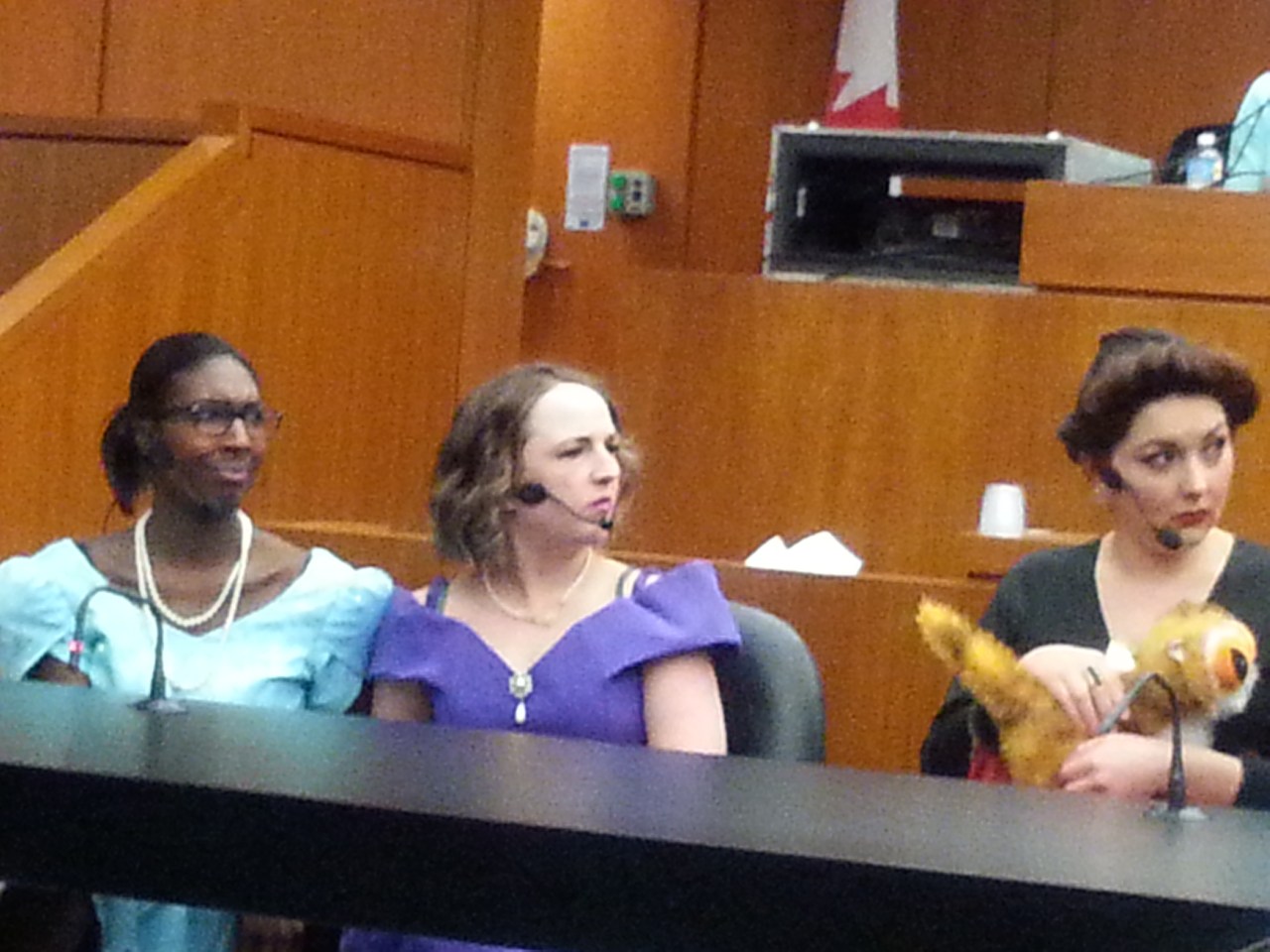
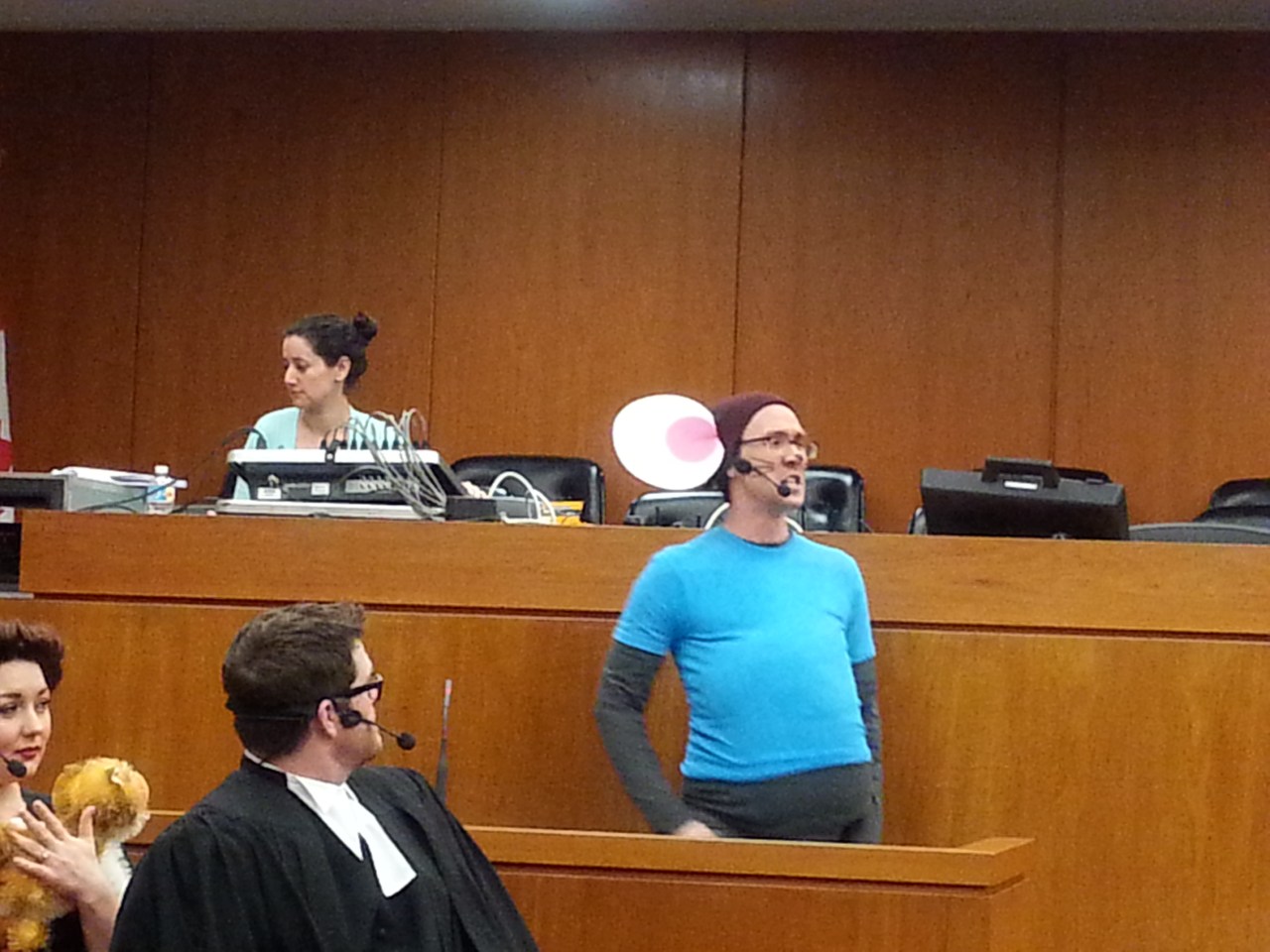
Cinderella’s trial is especially popular with families, whose children are well-familiar with her story and the characters who impacted her life. They watch in fascination as the evil stepsisters, Lady Tremayne, and her evil cat, Lucifer, listen to the evidence against them, and giggle delightedly through Gus Gus the mouse’s testimony.

20160416_10135620160416_102549

When Lady Tremayne takes the stand, we find out that she not only worked Cinderella remorselessly, but also falsified Cinderella’s father’s will so that all of his wealth would find its way to her and her daughters. How has Cinderella’s lawyer deduced this? The will that Lady Tremayne produced has all its “i”s dotted with a heart, in the same way that the letters appear on Cinderella’s demanding work schedule. The original will did not.

Lady Tremayne is also questioned about her failure to send Cinderella to school. “Oh, but I home schooled her,” she says, smugly.

“And did you follow the standard Alberta education curriculum?” the lawyer probes.

Lady Tremayne sniffs in disgust. “I don’t believe in following any standardized curriculum. The education I gave Cinderella allowed her to graduate from the School of Hard Knocks, the University of Life!”

“Neither of which are degree-granting institutions,” observes the lawyer. “No more questions, Your Honor.”

Lady Tremayne makes one last effort to clear her name.  With her own rendition of Justin Bieber’s “Sorry,” she tries to get Cinderella and her lawyer to grant her “one more shot at forgiveness.”20160416_103714

But it’s too little too late. When the judge asks us to return our verdict with our applause, we decide in favor of Cinderella.

As moms and dads gather up kids and coats, and little girls pose shyly with Cinderella, I hear lots of children of all ages ask “What are we going to do next?” There is already a lineup for the next trial, and crowds around the booths downstairs.

It’s thrilling to see the imposing Edmonton Courthouse taking on the role of educational institution. The lessons I received in school about Alberta’s legal system were delivered via droning lecture in a traditional classroom.  But the organizers of Alberta Law Day saw the potential for a more innovative teaching approach. Kudos to them, and to everyone who gave up their Saturday  to inspire kids and their parents to learn about the law.


Interesting footnote to my post of a couple of days ago.

University of Alberta President David Turpin sends a regular newsletter to all University employees to update us on his activities. On Friday, he told us about his recent business trip to Europe, which included a stop in Belgium:

One of the most remarkable moments of the trip occurred as we left Belgium via the Brussels airport. Due to the terrorist attacks earlier in March, we had been offered the chance to reroute our flights but we decided not to change plans in support of all those affected by the tragic events. As we passed through the parking lot check-in tents at the recently reopened airport, we kept encountering airport staff and military personnel who went out of their way to be friendly, helpful, and attentive. They were subdued, but their resilience struck me as extraordinary given what they had been through only weeks before. 

Amen, David.

DSCN0669

DSCN0754 (1)It was one of those serendipitous e-mails that made my heart sing: my friend Livia was going to be in Brussels at the same time I was.

We had met six years before, when we spent a long and miserable year hating Winnipeg together. I had arrived from Edmonton, and was trying to convince myself that I could fit into the life of a tenure-track academic. Livia,  Hungarian by birth with a recently completed post-doc from the University of British Columbia, was working at a corporate job in environmental economic forecasting.

We met in a Saturday afternoon drama class where her cheeky responses to the cheery instructor’s get-to-know-you questions  (“No, I don’t like Winnipeg. No, I don’t like my job either”) made me seek her out at the class break. We kept each other propped up that year with brunches, dinners, shopping trips, and commiserating stories about how hard it was to make friends in Winnipeg. By June, I had resigned my position and was back home in Edmonton. Livia would tough it out in Winnipeg for several more months before accepting a job transfer to Ottawa.

We had connected a couple of times since that – once when her job took her to Calgary, and once when I visited her in Ottawa. But to meet Livia in Brussels made me feel exotic, like an international jetsetter from a 1950s black and white movie (“Oh, yes, dahling, of course I’d love to have a glass of wine with you next weekend DSCN0772 (1)in Belgium.”)

By the time Livia arrived in Brussels, my husband and I had been there for several days, and had already visited some of the city’s famous landmarks : the naughty Mannekin Pis; the Atomium, a DSCN0762 (1)leftover monument from the 1958 World’s Fair; the glittering guild halls of the Grand Place. So the time I spent with Livia would centre around girlfriend walking and talking with Brussels as our backdrop.

Because we hadn’t set out from our hotels with particular destinations in mind, we were delighted by discoveries every time we turned a corner. Early in the day, we ran into the start of some sort of children’s festival, featuring balloons of every size and shape.

Closer to the Grand Place, a beerfest was just getting underway, its pageantry creating a far more elegant celebration than any beer-associated event we’d ever attended in Canada.

Unlike our shopping trips in Winnipeg, that Saturday we were more interested in browsing, an activity elevated to the realm of awe-inspiring by the designers of Brussels shop windows.

This slideshow requires JavaScript.

And because we often paid more attention to our conversation than to our city map, we frequently misjudged both how long it would take to get to a certain street and how to get back to it when we overshot. These oversights led us off the beaten tourist paths and into the Saturday routines and celebrations of ordinary Brusselaars:

DSCN0806 (1)DSCN0765 (1)DSCN0709 (1)DSCN0690DSCN0774 (1)


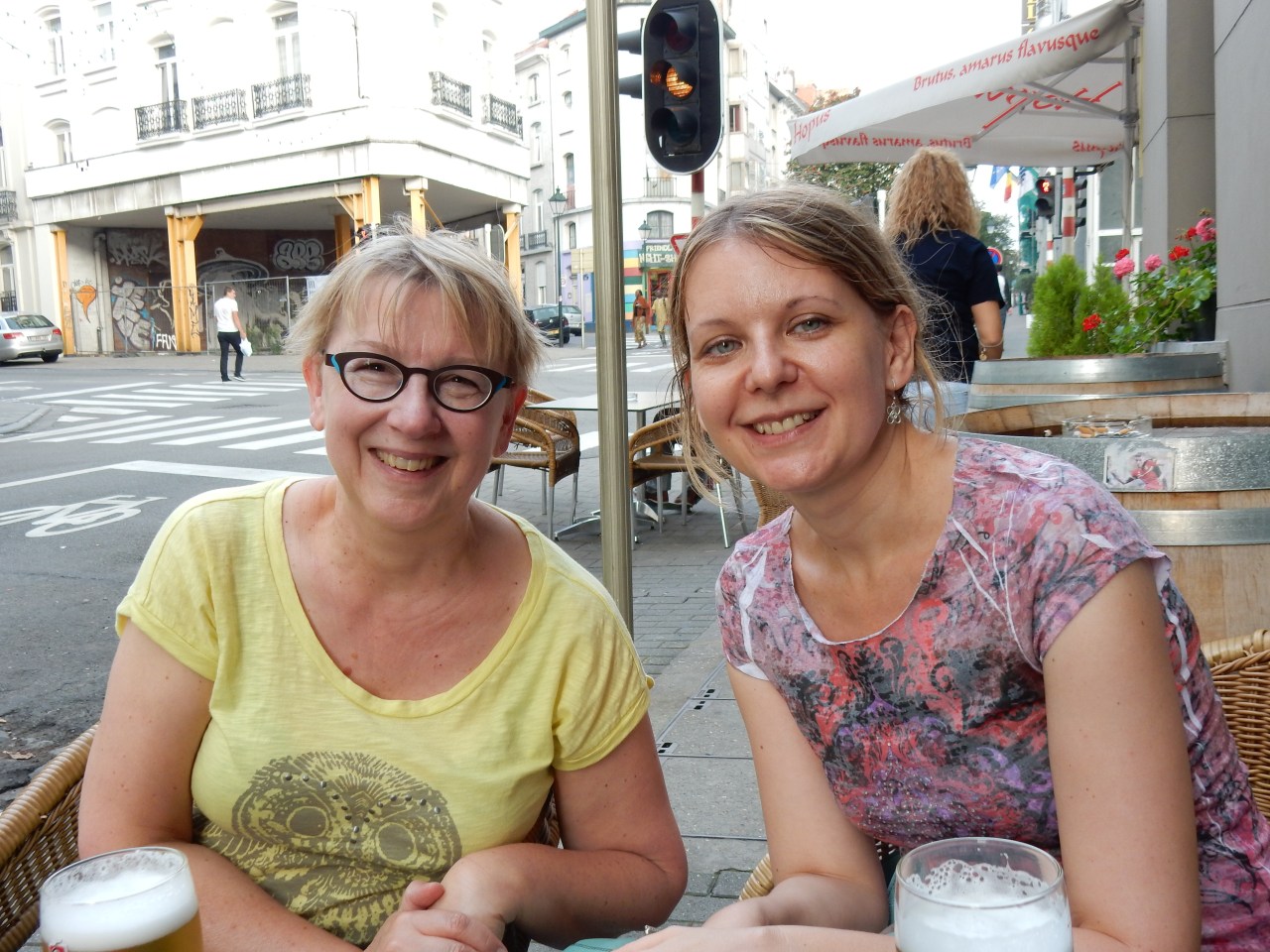
By the time we sat down for own beer at the end of the day, we were not only reacquainted with each other’s lives: we felt as though we had made friends with Brussels too.

***********************************************************************

Two years later, I had trouble reconciling the  joie de vivre photos I had taken during our walk around Brussels with the images  that dominated the media after the terrorist attacks: a man  lying next to his overturned suitcase at the airport; emergency workers helping an injured passenger leave the crumpled subway station; a woman sitting dazed in front of a shop, covered in blood and concrete dust, while another made a desperate call on her cell phone. I didn’t want to recognize the places in Brussels where those photos had been taken. But I’d passed through that airport with my husband. Maybe we’d even had coffee at that Second Cup where one of the bombs was detonated. I knew where that subway station was, and I wondered if Livia and I might have walked down the street where the two women were photographed. I didn’t want to, but I thought, that could  have been us. 

In the days that followed the attacks, I watched headlines that tried to make sense out of senselessness:  “Grim Awareness, Suspicion Spreads As Brussels Reels From Bombings;” “Is This The War We Can Never Win?”; “Terror As A Fact Of Life.” But every now and then, in the dark aftermath, I saw a glimmer of hope in the news.  My hometown school board announced they would not cancel all international student field trips, preferring to evaluate each on a case by case basis and leave parents with the final decision.  Marsha Lederman, a Globe and Mail columnist, discussed how the randomness of such tragedies make us feel vulnerable because the people involved are just like us. They couldn’t have known what was coming when they lined up at the check-in counter or boarded the train in Brussels that morning.  “One minute you’re travelling on business, or taking a bucket-list vacation, or heading to the office. And the next, it’s over.”

Lederman’s piece on the nature of randomness may seem like an odd place in which to find hope. But she reminded me of a truth that most of us know but choose to ignore: that life has many unscripted moments over which we have no control. Sometimes, those moments alter life negatively: we, or someone we love, lose a job, or a family member, or get a gut-wrenching health diagnosis. But that randomness can also bring overwhelming joy: we meet a stranger in a coffee shop at just the right time, or pick up the phone when we hadn’t intended to, or round a corner in a European city with a friend who just happened to be there at the same time we were.

So, I hope that if you’re planning a trip to Brussels, or any other place in the world, that you screw up your courage and get on that plane. If you’re a parent whose child is heading off on an international field trip, I hope you give them a long hug and let them go. The only way that terror will become a fact of life is if we let it. And that’s a situation over which we absolutely have the last word.


Pack your bags/We’ll leave tonight.

(Eddie Money, 1977)

DSCN2166On the Wednesday before our Saturday departure from Rarotonga, someone at breakfast dares to raise the subject.

“Well, back to real life in four days.”

No one says anything for several seconds.

“I won’t mind,” says one woman, looking up from reading the newspaper. “Time to get back to my regular routine.”

“I’m not thinking about leaving yet,” says a man on his way for another cup of coffee. “I’m pretending that someone has just now dropped me off for a four-day weekend on Rarotonga, and my holiday is only getting started.”

“All this talk about getting back to real life,” chimes in his wife. “Maybe the time we’ve been spending here is real life, and it’s our lives back home that aren’t.”

At exactly 9:15 p.m. on Saturday, the shuttle bus to the airport arrives. Those of us whose vacation is over straggle out of our homes away from home, wearing the jeans and runners we had stashed out of sight in our closets two weeks ago. A few people who are staying longer call goodbye from their porches as we haul our suitcases across the grass and down the road to the waiting bus. No one says much on the way to the airport.

DSCN2615Although we glimpse each other once in a while on the flight to Los Angeles, and again in the LA airport as we kill time before travelling to our home destinations, our little Raro travel community quietly dissipates. Sixteen hours later, my husband and I arrive home to a dark house, and minus 10 C. Two days after that, I’m waiting in my parka at 7:45 a.m., not to flag down Rarotonga’s clockwise or counterclockwise coach, but to board a regularly scheduled, on-time, Edmonton Transit bus to go to work.

I think about the woman in the breakfast room wondering which was more real – her blissful, temporary life on Rarotonga, or her responsibility-laden, permanent life in Alberta. I saw the dichotomy discussed again in a newspaper article last week, contrasting university attendance with the “real life” of the post-convocation work world. In both contexts, reality seems to be defined as the drudgery of regular job and domestic routines, kind of a sad statement on the state of adult lives.

DSCN2344I’m more in favor of finding ways to bring together our vacation selves with the sometimes Storm Trooper realities of our back-home lives. Even though Rarotonga’s temperatures won’t be visiting Edmonton for six more months, the Pacific Ocean is entire province away, and speakers of Cook Islands’ Maori are as scarce as palm trees, I’ve discovered a few ways to keep the rareness of Raro alive during real life back in Edmonton.
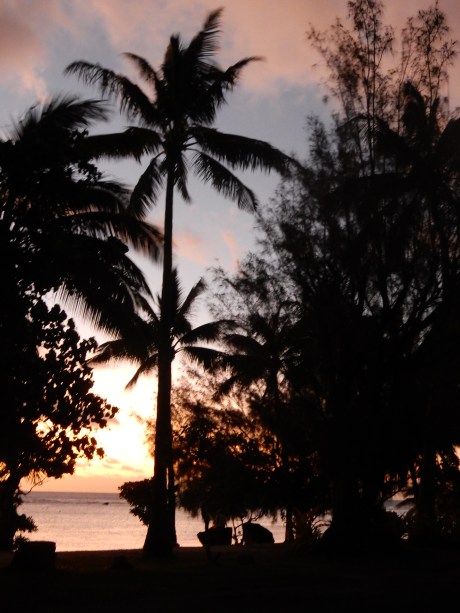
  1. A friend’s Facebook photos of our winter sunrises reminded me that the Cook Islands aren’t the only place where you can experience tangerine skies. Before Christmas, I’d been missing those colors because I was already checking my work e-mail on the bus ride into downtown. Now, my phone stays at the bottom of my purse so I can look out the window.
  2. And speaking of my phone, it sometimes goes uncharged now for days at a time. I did without it for two weeks’ on Raro; do I really need to get back in the habit now that I’m home?
  3. Doing without on Raro also extended to the number of clothes I packed to wear. Granted, in a tropical country you don’t need as many, but there was a simplicity to getting dressed in the morning that I’m trying to duplicate now that I’m home.
  4. Part of the delight of a vacation is getting up in the morning and wondering what new and interesting sights you’ll discover before the day is over. So, I’m trying to see familiar sights as a traveller would, to marvel at the feathery tracings of bird tracks on new snow or laugh at a poodle picking its way along an icy sidewalk in a red plaid coat and matching boots.
  5. A long ago Chinese philosopher said that to re-create something in words is like being alive twice. It may be frigid February outside my Edmonton home, but inside I’m blogging the hibiscus back to life, savoring the fish and chips, and watching the waves leap over the coral reef one more time.DSCN2652